While I love this blog, I now pretty much only write on my other two blogs: BirdingBlogs.com and 10,000 Birds - I would love to see you there!

Wednesday, 14 May 2008

Red-footed Falons on the fly

On Sunday afternoon, the wife and I headed out to our local birding "patch": its a lovely little pond, frnged with reeds and rushes, surrounded by fields, and with a spectacular gallery of overlooking mountains. I only "discovered" the spot a few weeks ago after a friend asked if I had been there. Needless to say, I am now hooked.Sunday was a lovely day. Just as we got to the pond, I saw another birder there (one could tell by the cumbersome piles of optical equipment hanging off of various limbs and "tripodded" at the ready). Now this is not a common sight in Tirol. Spinning around I got my second unusual sight. A little falcon sitting on the line. At first I took it for a kestrel. But one look at her light wannabe hood dispelled that misconception.

Seven years not having seen a red-footed falcon (Falco vespertinus, Rotfußfalke) and it seems I had gotten a little rusty. I took me a good minute to be sure what she was. As I looked about, we found at least 7 red-footed falcons about (only two adult males). They would glide over the field, pick up a flying "May beetle" and, in typical red-footed falcon style, eat it with both feet in the air (incidentally, the Milvus kites also like to do this). Between these short feeding forays, they would head back to a power line and sit for a bit. Tangentially, it occurs to me that maybe the life of a red-footed falcon was a little less interesting before power/telephone lines.

It seems we only really get these little falcons here at migration time when they move up from the dryer savannas and grasslands of southern Africa in to the Palaearctic steppes to breed. They make little stops on their journey to fill up on insects in the spring-touched fields (basically birdy road-side service stations).

To identify the females and youngsters, keep a look out for the indistinct face mask, buff underparts with varying degrees of streaking (most adult females tend to have only a very little bit of streaking on the side of the belly and chest). She is barred grey on the back and wings. Adult males are easy: dark slate grey everywhere, except for the red of feet, undertail, and face.

Red-footed falcons breed in loose colonies, but roost colonially during the non-breeding season. Nests are often "adopted" from various species of corvids and individuals can live at least 13 years.

Their horizontal flying speed is about 46 km/h, about the same as for most other raptors (Bruderer B 2001 Ibis 143). Evidently (and not unexpectedly), 46 km/h is just too quick for a couple of little bugs.

The German wikipedia entry for the red-footed falcon is pretty good: http://de.wikipedia.org/wiki/Rotfu%C3%9Ffalke so if you can read German and are interested, it is really worth checking out.


In the event you were wondering, many of the pretty bird pics are not mine: when I want to make a point (or just for beauty) I include a "creatve commons" photo from flickr. If the photos are not ine then I always provide a back link to the original location where I found the photo.

Wednesday, 7 May 2008

More photos from Lago di Garda, Italy

I wanted to add a few more bird (birding and other) photos from our trip to Lago di Garda, northern Italy.
This is a shot taken one dawn from one of the beaches near Manerba dei Garda, looking towards the cliffs of La Rocca (where I did most of my birding).

Looking out over the ocean. There were a good few pairs of Yellowlegged Gulls flying about, as well as common swifts and alpine swifts, crag martins and barn swallows. Sardinian warblers were calling in the background.


Two more shots of the incredibly cute redcrested pochards that were hanging about the port at San Francisco de Garda (all taken through my binoculars).


And a reed warbler singing away in the reed bed near the point at San Biaggio. There were about 30 singing there in this tiny little reed bed. A couple of little sedge warblers were also hanging out between them, but were completely silent and tended to be lower in the reeds, feeding right near water level. But, they were also more likely to use the non-reed material for perching, i.e. the sticks and fallen branches that lay about.

Monday, 5 May 2008

There is more to see in Italy than Sparrows...

There are also Blackbirds. Before heading down to Lago di Garda last weekend, I had a look around the net to see what there was about birding in northern Italy. And the sparrow comment came from somewhere there. In fact, I ended up seeing a good few species of bird over the weekend. Birder's paradise it was not, but there was certainly lots of fun to be had. We chose a campsite near the little forest patch (La Rocca) between Manerba and Moniga, on the southwestern part of the lake. GoogleEarth seemed to suggest that, while being a fairly built-up area, there seemed to be at least some natural vegetation in which I could find something interesting.

As soon as we got there, I was off with my binnies to see what I could see. Tons of Blackheaded Gulls (Larus ridibundus Lachmöwe) feeding and relaxing just off shore, with a few of the much larger Yellowlegged Gulls (Larus michahellis Mittelmeermöwe) hanging around. Not a single wader running along the pebbled shore, but a single pair of Dabchick (Little Grebe) and a couple of Great Crested Grebe pairs certainly made up for that.

I eagerly headed over to the forest. But it seemed like the only birds I saw were these annoyingly fleeting glimpses of fleeing birds. It seems that centuries of hunting birds (even the littlest of passerines) has left them with a well-developed fear of humans and I had to become very creative just to get a look at a bird through my binoculars (as a side note, I found six different shot gun cartridges in the forest). Eventually I learnt to sneak quietly through the forest and look for birds in the distance, and through gaps in the trees. If I saw them early enough then I generally got a decent look. At this stage you might be wondering why I did not just listen to them and identify them by call. I wish I were that good (I am trying to learn them though, I promise).

Through stealth and persistence, I managed to find some nice birds. I found the Sardinian Warbler (Sylvia melanocephala Samtkopf-Grasmücke) to be fairly widespread and common, but incredibly shy. A lot shyer than the very vocal Blackcap (Mönchsgrasmücke). The best way to find the Sardinian Warblers (as with all the other warblers) was definitely by call, and in the late afternoon, there were often a good half a dozen singing from the tops of the trees/bushes along La Rocca's higher savanna-like ridges.

The late afternoons were also a good time to look out for the wing feeders. Barn Swallows (Rauchschwalbe) and Crag Martins (Felsenschwalbe) would buzz the open fields and cliff edges, and House Martins (Mehlschwalbe) would feed over village edges. Apparently, the Common Swift (Apus apus Mauersegler) traditionally gets back to Austria on 1 May each year, so I was on the lookout for them. 1 May came and not a single Black Swift (but a good few Alpine Swifts!). But the morning of 2 May, suddenly they were about. A brisk wind was blowing up off of the lake, and lifting up against the lake-side cliffs; much to the delight of the 30-odd common and alpine swifts gathered there. I swear they were playing. So graceful. So incredible.

The mixed scrub, forest and fields, also yielded a few pairs of Nightingales (Nachtigal, click for map), a Pied Flycatcher (Trauerschnäpper, click for map), a Grey Partridge (Rebhuhn), and dramatic vistas across the lake. Walking back through the fringe farmlands, I found a couple of pairs of Hoopoe (Wiedehopf, click for map of 2 locations) and lots of Hooded Crows (Nebelkrähe).

The little reed bed at San Biaggio (here) produced about 30 singing reed warblers (Teichrohrsänger), two sedge warblers (Schilfrohrsänger), a moorhen (Teichrallen) nest and some coots (Blässhuhn). I also picked up a Common Whitethroat (Dorngrasmücke) feeding on some berries in this same area. Whilst walking through the camping areas, also keep a look out for the almost ubiquitous Spotted Flycatchers (Grauschnäpper) and Serins (Girlitz).

I took this photo of a Redcrested Pochard (Kolbenente) on the lake with my little casio digital camera held up to my swarovski SLR binoculars. I am quite happy with the result. Not perfectly sharp, but close.

So, it seems like there is at least something to keep the birder occupied around Lago di Garda. But before you go, brush up on those bird calls, and make sure you take your binoculars!


Friday, 25 April 2008

Alpine Swifts

I remember the day I first saw an Alpine Swift (Alpensegler, Apus melba). It must have been around Christmas time late 1990 or so. Hot. We were just driving in to downtown Durban as a wave of swifts shot over the car. Swifts everywhere! What a sight. As usual, most of them were whiterumped and little swifts (Kaffernsegler und Haussegler) but then these HUGE swifts came by. They looked like mammoths zooting across the sky. And with that bright white belly! I knew exactly what they were almost before I had even seen them.

Over the years I got more familiar with them. Dawn cape parrot counts overlooking Hlabeni forest were often greeted by the swooshing of razor-edged wings as they sped past our faces. Breathtaking. To say the least.

I was reminded of these lovely birds the other day when I found the most incredible photo-blog by Graham Catley. He had posted three images of Alpine Swifts feeding on the wing - some of the best swift photos I have ever seen.

And then yesterday afternoon I was peering outside (as I am wont to do) and there was a whole group of them feeding over the houses in eastern Zirl. There movements are so graceful, so, well swift. It seems they are just returning from their migration to Africa and we will hopefully see a whole lot more of them over the coming months, particularly in the mountain regions.

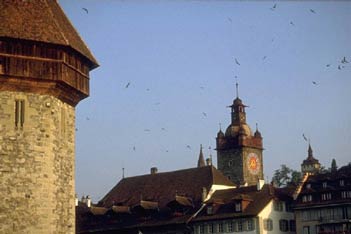
The photo that shows all the swifts circling the town (its just a wiki commons photo so I don't know where it is from) is often how you will see them - dashing quickly about. They are hard to track with your binoculars but their large size and white breast is likely to make their identification somewhat easier. Interestingly, while swifts (Segler) may look like swallows (Schwalben), they are only very distantly related. The easiest way to tell the difference between the two in the air is to look at the wing shape - swifts have long, thin wings that make them look like darting boomerangs. The swallows have a rounder wing shape, not as sharp as the swifts.

The swifts belong to the order Apodiformes (meaning no feet. hummingbirds are also in this same order), an apt name for a bird with such tiny legs and feet. Talking about feet, the difference between swift and swallows is immediately obvious when one has them in the hand. Swifts have pamprodactyl feet which means that both the first and fourth toe can swivel forward so that all four toes are in a row. This helps the swifts cling to the cliffs when they (very occasionally) land. You can see this clearly in Prof David Norman's photo, left. The swallows have decidedly longer legs with normal bird feet, i.e. three toes forward one back. The swallows are much more likely to perch - they are the ones that you see sitting on telephone lines alongside roads and fields.

Alpine Swifts prefer to breed in cliff or cave nest sites, and generally lay two to three eggs. The adults feed exclusively on small insects caught on the wing, which means that during cold and wet periods, flying insect food can be severely limited. Incredibly, it seems that the chicks are able to survive these enforced fasts by reducing their body temperature (torpor) and by mobilizing the energy in their relatively large pectoral muscles (Bize, Klopfenstein, Jeanneret & Roulin 2007 Journal of Ornithology 148/4).

If you are interested in their breeding, check out the webcams of two Alpine Swift nests in southwestern Germany.

Happy birding, Dale Forbes


Monday, 21 April 2008

The Ptarmigan


I found this gorgeous image on Flickr and really wanted to share it (click on the link to go to the original site). Leafing through my bird book a few months ago, I saw the Ptarmigan (here, better known as Alpenschneehühn Lagopus muta) and I was struck by its stark beauty. There are very few pure white animals in the tropics, and they really do stand out when you see one so, I must admit, that I have a natural draw to beautiful white birds. And then, quite unexpectedly, I was snowboarding at Patscherkofel one day, and a group of five startlingly white Ptarmigan flew over. A few weeks later, I got to see some in Serfaus-Fiss-Ladis, and again in Kühtai. It seems that they really like the areas near the top of the tree line (about 2000m) or higher. In spring, they lose their lovely white plumage for a better camouflaged brown flecking, and the males get a bright red comb. The brighter and bigger the comb, the better his chances are of successfully breeding!

So, if you happen to be high in the mountains, always keep a look out for these little guys as they fly around in their little groups.

Happy birding
Dale Forbes

Sunday, 20 April 2008

Goldcrests and firecrests flitting through the trees

There were a bunch of little goldcrests out this morning. Very shy, flitty little birds. Apparently they are the smallest bird in Europe. Well, they are certainly not large! While the rest of the BirdLife Austria group was chatting, I took some time to follow their movements to try to see a little of their characters. I found one little guy collecting nesting material - darting all about, here and there (they certainly are flitty little birds). I suppose this guy was building his nest in the heavy, leafy ends of one of the conifers - hiding the next generation away in its dense, protective cover.

Incredibly, the female goldcrest (Regulus regulus, Wintergoldhähnchen) incubates the eggs alone and is not regularly fed by the male and the total mass of eggs can be 50% more than her body weight (Haftorn 1978 Ornis Scandinavica 9)! Despite doing it all along, these little 5gram females are able to keep the temperature of her brood remarkably constant, by varying the amount of time she spends on the eggs (and away from the eggs)(ibid).

A very closely related species to the goldcrest, is the equally adorable firecrest (Regulus ignicapillus, Sommerhähnchen). Both are exceptionally flitty species; never sitting still and always darting from one branch to another. And even when they do seem to be on one branch for more than 10 seconds, they tend to flap and shake their wings. This is typical behavior of small insectivorous birds (willow warblers, tree creepers, white-eyes and many others also do this). By flicking their wings, the sharp movement tends to startle little well-camouflaged insects just enough to get them to move. And even if they move just a wee bit, the sharp eyes of the insectivore will spot them (and eat them for breakfast!). But despite looking very similar and both feeding on small insects, it seems that their territories can overlap extensively (no interspecific territoriality) and they differ in how they feed (Leisler & Thaler 1982 Annales Zoologici Fennici 19/4).

To tell these two little guys apart, birders look at their cheeks: the firecrest has strong black and white eye stripes (see left). Compare this to the plainer cheeks of the goldcrest above. But even easier than trying to look at their make-up is to just listen to them: they both have very distinctive calls. Try these links to the RSPB site to listen to how they sound!

firecrest
goldcrest


Happy birding,
Dale Forbes


Thursday, 17 April 2008

The Warblers Are Back

The gorgeous little Blackcap (Mönchsgrasmücke). I had been wanting to see one of these for years and years and years. But, South Africa is not famous as a major Blackcap destination. In fact, as far as I can tell, only a couple have ever been seen in the sub-continental region (the story goes that the first blackcap ever found in the region was actually caught in a mist net near Johannesburg!).

And so, along with the joys of seeing all the other migratory birds returning home, it is great to finally meet the blackcap. Last week there were none. This week, they are like sparrows falling out of every bush!

It seems that in preparation for migration, young blackcaps (Sylvia atricapilla) move about completely randomly as they search for food to fatten up for the migration ahead (Chernetsov 2002 Journal für Ornithologie 143/4). The ones that migrate down in to Africa tend to follow the high mountain ridges. At regular stop-over points, the blackcaps settle to rest and try to feed a little. At this stage, they seem to remain within a fairly restricted area (i.e. not wandering off too far), but the area is too large to be considered a defended territory in any way.
Interestingly, blackcaps reliably use fruit color to determine the levels of anthocyanins (an important antioxidant) in fruit, and the anthocyanin level is also correlated with the total calorific content of the food (Schaefer, McGraw & Catoni 2008 Functional Ecology 22/2). Thus, blackcaps are able to select the nutritionally most advantageous fruits based on fruit color. But if only unripe fruits are available, blackcaps tend to rely more heavily on insects for food (Schaefer & Schmidt 2002 Journal für Ornithologie 143/3).

Dale Forbes

Sunday, 13 April 2008

Yellow wagtails, grey wagtails and great big Golden Eagles!

I have always had an interest in wagtails. There is something about their nature that always caught my eye. That calm demeanour. And a ritualistically wagging tail. It is like looking at a monk calmly chanting his maha mantra. I remember being fascinated by the little cape wagtails that visited our garden as a child. Scoured every brook for a longtailed wagtail, and never failed to point out the odd pied wagtail. A little later, the pipits (basically ridiculously difficult to tell apart brown versions of wagtails) drew my attention.

This morning we went out on a joint walk with BirdLife Austria, and WWF to Schloss Tratzberg to walk about in the fields and stream-side habitats. Early on, we found a few cute little birds; some of my favorites being the european blackcap and the jackdaw. But when the sun started to rise in the sky, and the day started to "warm" up a bit (all relative of course - the snowy peaks do not lend themselves to warm mornings), the wagtails started to come out.

A gorgeous grey wagtail presented himself for examination alongside a little stream. Our competant guide Andreas Schwarzenberger regaled us with his trick to telling the grey from the yellow wagtail: "It's easy" he said "just look at the colour of their back." You see, both species are rather variable in their coloration but their back color is always rather constant: if it has a greenish or brownish back, it's a yellow wagtail, and if the back is grey then (you guessed it), it's a grey wagtail. Easy when you know how!

The day's highlight was, for me, two gorgeous golden eagles. Granted, I am prone to exageration. But these birds were absolutely incredible. They were way up, circling the peaks and they still looked impressively large. One of the birders had brought along his Swarovski telescope, affording us great views as they circled in and out of the morning mists. Previously, I had thought that they may be somewhat difficult to tell apart from other large raptors, but their distinctive eagle wing shape and their sheer size gave these guys away in a snap - keep a look out for the bulging trail edge to the wings (thanks Andreas!), and the enormous wingspan.

To add to the day's raptor tally, we also saw a couple of black kites (sorry, couldn't resist noting them here), a steppe buzzard and a pair of greater kestrels (being mobbed by the jackdaws).

All in all, a lovely morning.


Dale Forbes

Tuesday, 8 April 2008

A Black Kite!

Wow, sweet!
I went for a mtn bike ride this afternoon along the Inn and saw some pretty cool things wizzing by. (that is me trying to convince you that I ride fast - did it work? I didn't think so, I had trouble convincing myself as well).
I did, however, get some great views of a black kite that was scouring an open field near Mötz. I really loved always having the kites around when I was growing up and every year we would check the sky religiously at the beginning of August (did I remember the month correctly?) to see when we spotted the first kite. Invariably, they would be seen on the northern KwaZulu-Natal coast first, then around Durban, working their way up the N3 towards Johannesburg and then explode throughout the country. It was always rather dramatic and certainly very exciting.

So, seeing my first kite of the northern hemisphere season brought back lots of happy childhood memories. Now, I am not going to get all pop-psychology on you, but it was rather cool. I hope to see more. Soon. I must say, it is fascinating to see all these species that I knew from southern Africa migrating here, and seeing them here in their "other" home. It brings a whole new dimension to my birding life.

The Alpine Winter was, however, a rather dull time for birds. My bird list remained static for months and I was forced to amuse myself with other hobbies. (skiing and tobogganing are, luckily, more than a little fun, so I was not too depressed). But now, with the onset of spring (oh, if someone sees the manager in charge of the weather, would you please tell them to turn the snow machines off already!) we are seeing lots more birds about. and they are all singing. the blackbirds sing their beautiful Turdus lyrics and the crows are building nests. Oh, and if you have never seen a Gold Finch Carduelis carduelis (here they call it a Stieglitz) then do yourself a favour and find one! Their lovely little white-rimmed scarlet faces makes them looks like they got a little too excited about the whole lipstick thing and permanently ruined their porcelain white doll faces.

The sun is due to make a bit of an appearance this weekend so I plan to take the plung and dust off my swarovski's and hit the woodland. If you live in the Alps (or anywhere else for that matter) you should probably do the same because, honestly, what can be more rewarding than finding a pretty little finch to look at as it fluffs itself up for the ladies!