While I love this blog, I now pretty much only write on my other two blogs: BirdingBlogs.com and 10,000 Birds - I would love to see you there!
Showing posts with label Videoscoping. Show all posts

Thursday, 22 October 2009

Videoscoping Squacco Heron

A couple of weeks ago, I showed a short videoscoped movie of a Blackcrowned Night Heron shot in Italy's spectacular Po Delta. Here is another movie from the same day, this time with a wonderfully lit Squacco Heron (Ardeola ralloides, Rallenreiher).


Happy birding!
Dale Forbes

Wednesday, 14 October 2009

Shorteared Owl, the power of digiscoping

this is one of my favorite videos I have made so far and I dont think I have posted it on my blog yet.
It is from our first day
birding with swarovski optik in kazakhstan this last may and starts with a typical steppe scene and a pile of interesting birders....

you'll have to watch the video to find out what happens next


go ahead, watch the video in HD

the scope is one of the new Swarovski Optik ATM80HD (that stands for "Angled Telescope Magnesium 80mm objective High Definition Flourite lenses), 25-50x wide zoom eyepiece, and the Swarovski DCB digiscoping adapter with my little Canon A590IS compact camera.

happy birding!
Dale Forbes

Thursday, 8 October 2009

Videoscoping Black-crowned Night Heron

Whilst in Italy's Po Delta in May, Clay and I found a great Black-crowned Night Heron - a great subject to practice a bit of videoscoping. It is just a short video, but it was a whole pile of fun to make.


Happy videoscoping,
Dale Forbes

Monday, 21 September 2009

I am a lousy photographer

It is true. or maybe better said, I am a lazy post-photography.

I loooooove taking photographs and digiscoping is IMHO the greatest thing ever. even since long before slice bread.

but then I take thousands of photos and post-process about one every few months. so I end up posting a whole pile of photos on my blog which have just been taken, resized ('cos I have a lousy internet connection at home) and posted. with a little bit of my garbled drivel to go with it ;-)

and then I got into video stuff. and even worse - videography. now this means that I can have tons of fun in the field filling external hard drives by the dozen (oh, much to my [lovely] wife's disgust, may I add), but it also means that I actually have to do a whole pile of post-editing before anything becomes remotes watchable.

And I am a lazy post-photographer. We've discussed this.

Anyhow, here is one video that made it through the cracks. It is of some Pied Avocets and Black-winged Stilts filmed in Delta del Po, near Venice in Italy.


check out the hot pink legs (as pinoyangelfish put it)

happy videoscoping!
Dale

Sunday, 28 June 2009

Videoscoping Wallcreepers on nest

So, here it is finally, the video of the wallcreepers (Tichodroma muraria, Mauerläufer) at the nest.


Wallcreeper (Tichodroma muraria, Mauerläufer) pair at nest

This is just a short videoscoping clip, but in some of my video footage, you can actually count four little bills, but there might even be five chicks in the wallcreeper nest. In the video you can see the male (the one with the larger dark patch on the throat) bringing insect food back to the nest. From my various photos of the male wallcreeper, it seems the food destined for the young chicks mostly consists of various Thysanura (wild, rock silverfish), a few species of spiders and at least one cricket. When the female was still on the eggs, the male seemed to be bringing her mainly nice large juicy crickets, but I suspect these were too small for the week old chicks at that stage so the cricket the male brought in was quite probably for the female.

Telling the male wallcreeper from the female wallcreeper is normally very difficult. Most field guides and online references I have read state that the male wallcreeper is largely black underneath in the breeding season and that the female only ever really has either a great throat or mild speckling. The male mostly looses his black belly and throat outside of the breeding season. What was interesting about this pair is that the female also had a fairly large black throat patch (see my first post and photos of the female wallcreeper at the nest). While the female was still incubating, the male had quite a large black throat and breast, but within a week, the male's black breast was fading fast. My last series of photos of the male wallcreeper show it with only the remnants of its black breast. It seems incredible that he was loosing his breeding colours so soon after (during) the breeding season.

The video was videoscoped from what I guess is about 25m with a Swarovski Optik ATM80HD telescope, 25-50xW eyepiece, UCA digiscoping adapter and a Panasonic Full HD SD100 camcorder.

Friday, 19 June 2009

White-crowned Penduline-Tit at nest

On our final day in Kazakhstan, we headed out of Almaty towards China and in to the deserts and semi-deserts of the region. After a couple hours' drive (which does not get you very far in Kazakhstan), we stopped at a little stream through some recently ploughed fields.


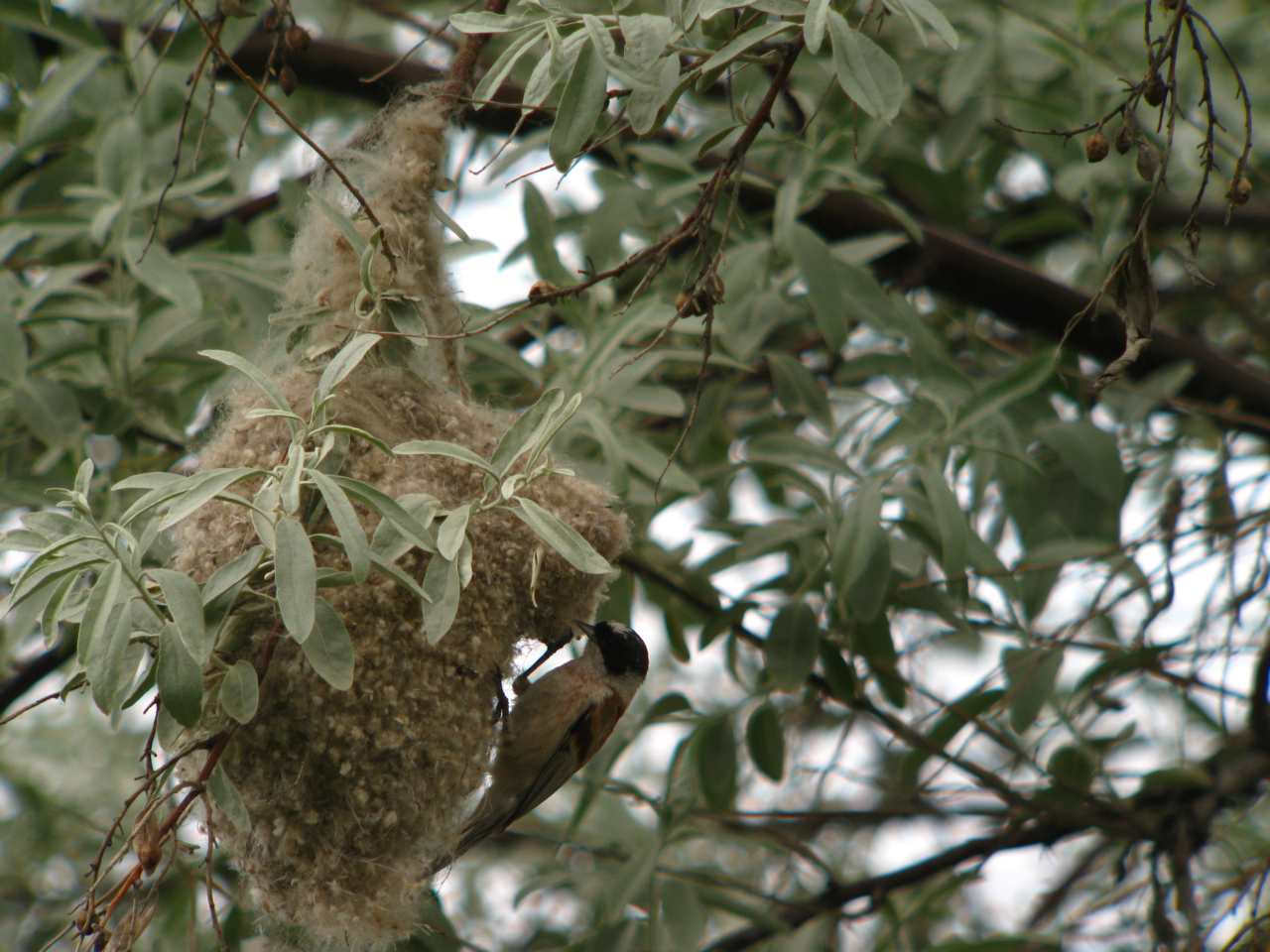
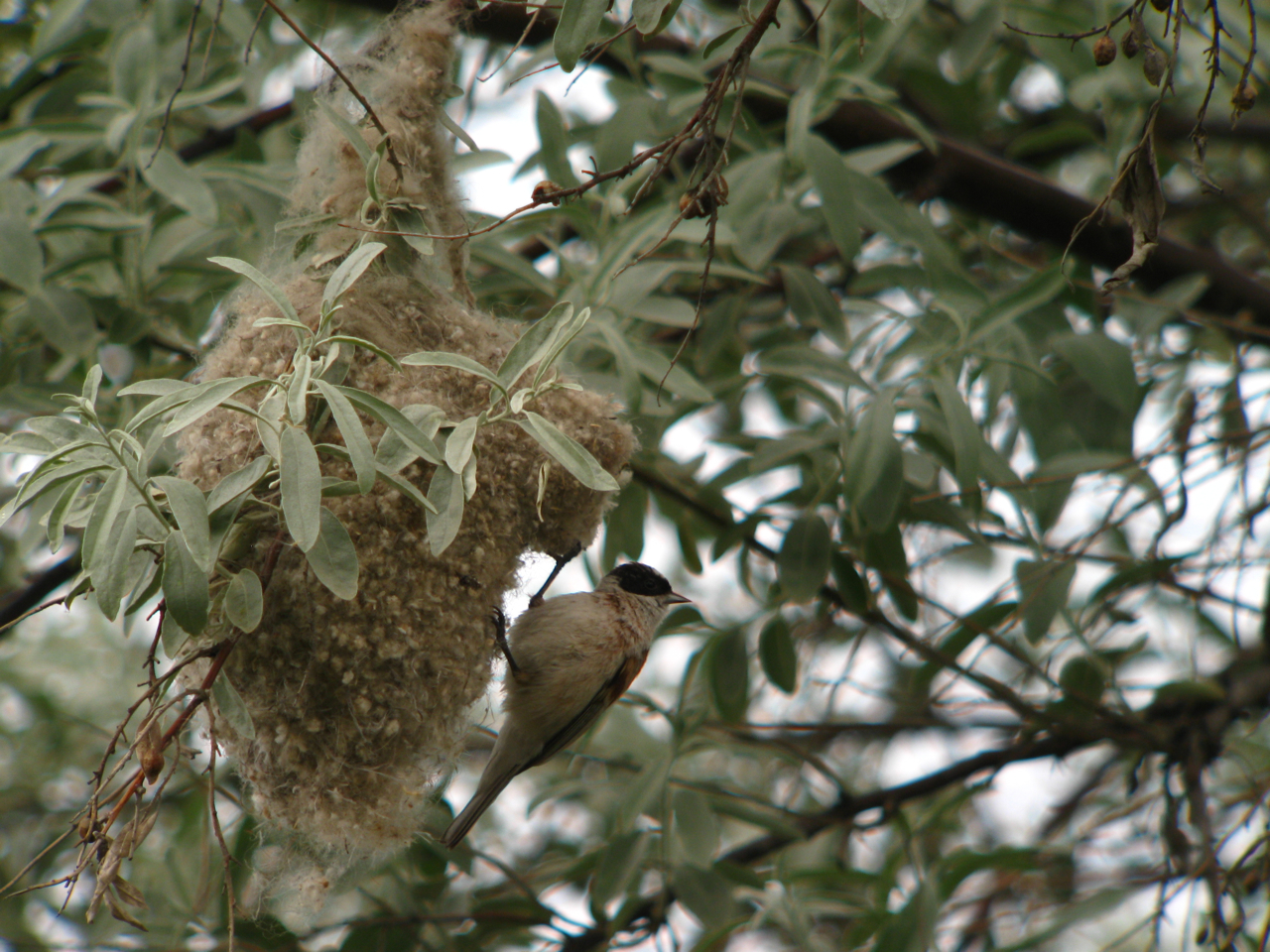
Strolling about, I ducked off in to the riparian woodland to see if I could get closer to a Lesser Grey Shrike when a tiny little White-crowned Penduline Tit popped up in to the bush above me. It didnt take me long before I found the nest. So we moved off a little and let the adults move in to the nest while we sat at the ready with our digiscoping gear.

White-crowned Penduline Tit (Remiz coronatus coronatus, Kronenbeutelmeise)

I managed to get a few nice digiscoped photos of this gorgeous little bird, but as the others left back for the car, a penduline tit came back and sat up beautifully for me. At which point the dinky compact camera got turned on to video move - the videoscoper in me coming out ;-)


One of the fascinating thing about Penduline Tits is that they have such huge nests because the top portion of the nest is a fake nest and the real nest is on the bottom story hidden below a trap door. In the video, you can see the penduline tit lift up the trap door flap with its bill just before entering the nest.

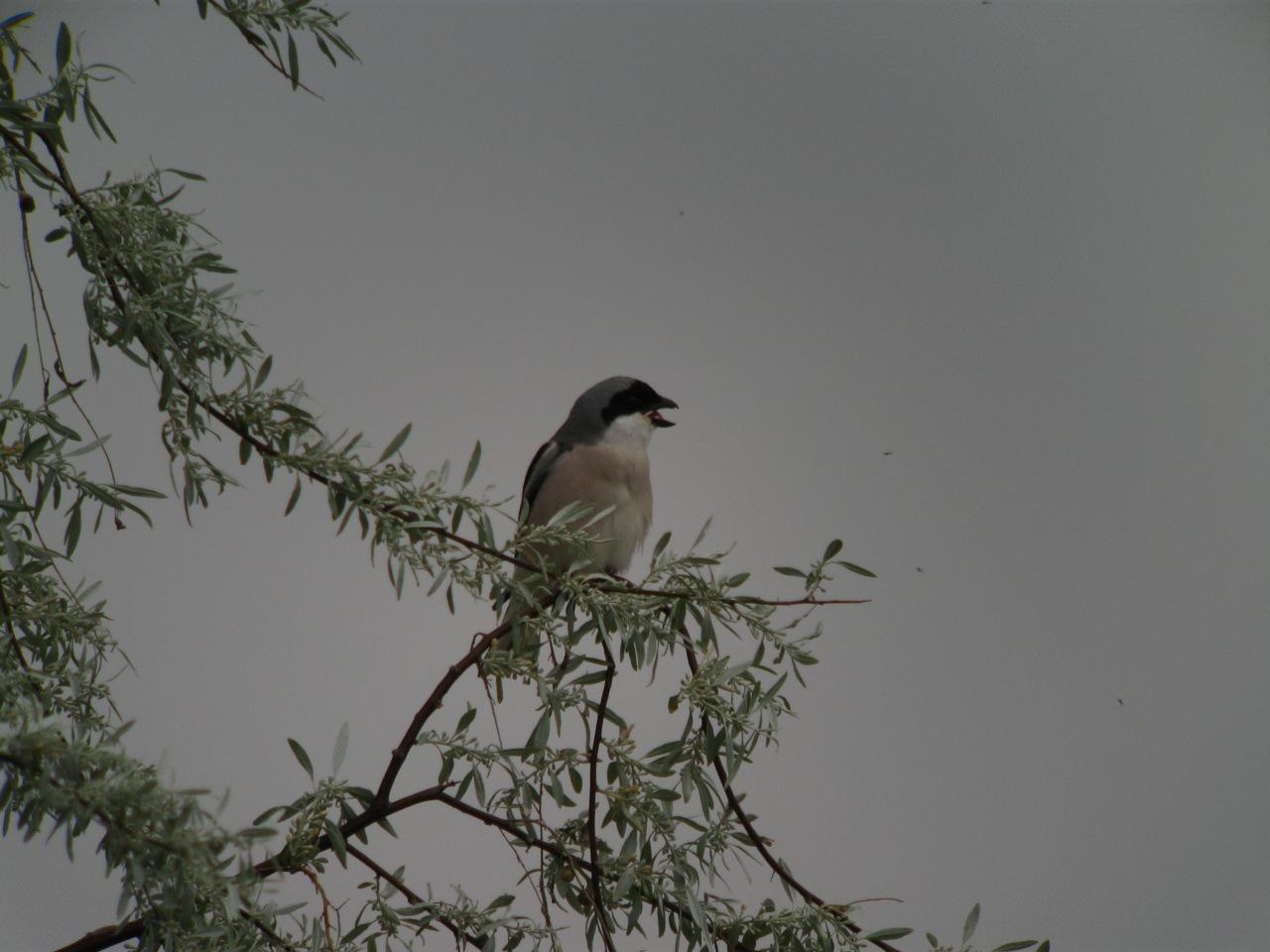
Lesser Grey Shrike (Lanius minor, Schwarzstirnwürger). Enjoying the mosquitos as much as we were? I wonder...

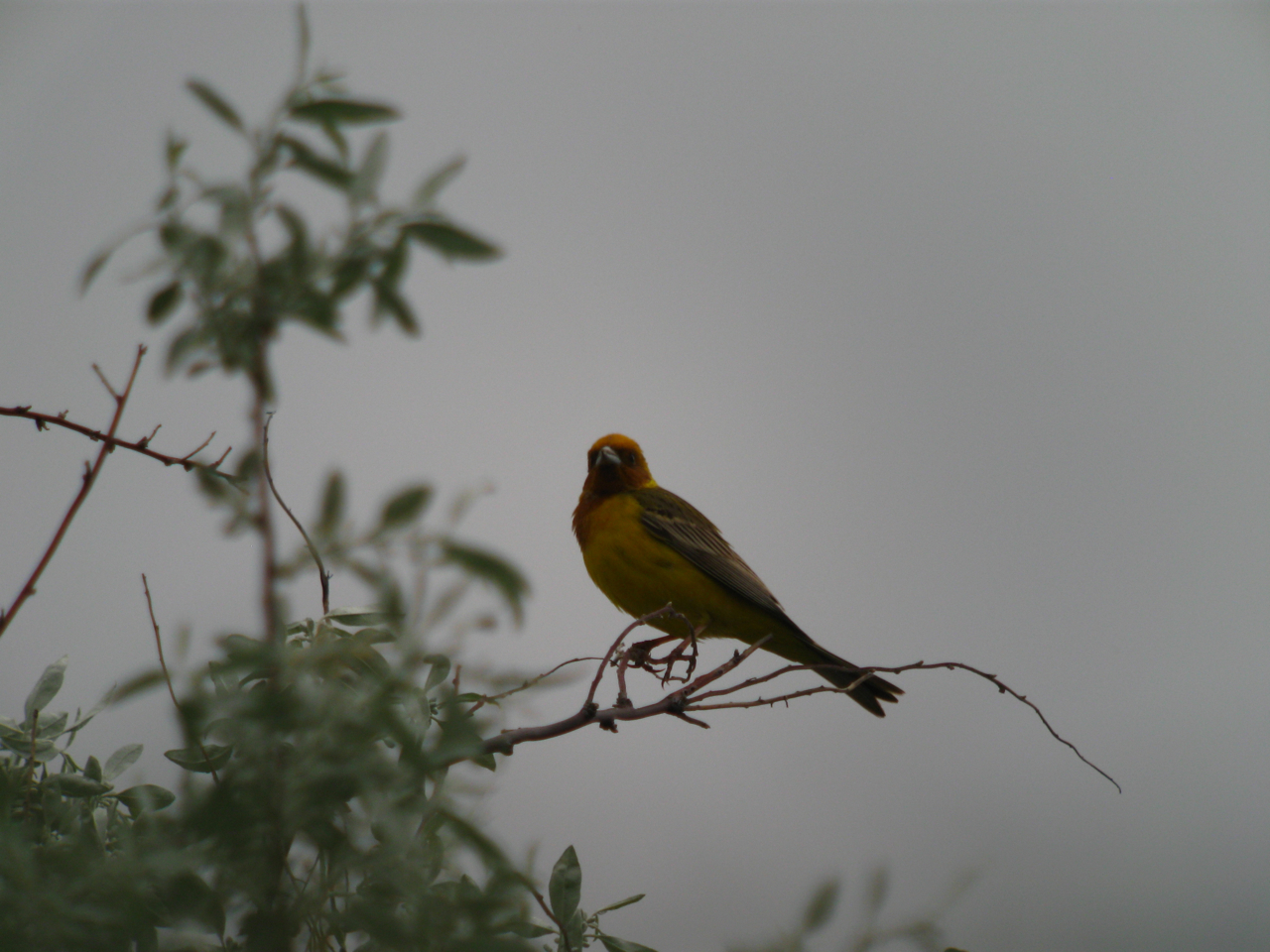
Singing Red-headed Bunting (Emberiza bruniceps, Braunkopfammer).

Happy birding
Dale Forbes


Thursday, 28 May 2009

Digiscoping and digiscoping adapters

I post lots of digisoping photos of birds on my blog. In fact, all my bird photos on my blog (and some of the people and animal photos too) are digisocped. And I don't think I have ever really posted about what I use, so here goes:

Digiscoping is basically using a digital camera to take photos through a telescope. Initially, cameras were hand-held up to the telescope's ocular lens. While this works, the extra stability and alignment benefits of having an adapter mean that it is much easier to consistently take good photos when you have a good digiscoping adapter/camera mount.

I have used a good number of adapters and digiscoping setups over the years. Over the past few years, I have used the various Swarovski Optik digiscoping adapters extensively. And they all have their uses so I generally choose one depending on what I will be doing that day. But the digiscoping adapter that really stands out to me at the moment - and the one I invariably pack - is The New Universal Camera Adapter (the UCA).

The Swarovski Optik UCA has only just been reveled to the press (which is what the Kazakhstan trip was all about). I will write a proper write-up on the new UCA in the next few days, and I also have a video on its use. When it is done, I will post it here.
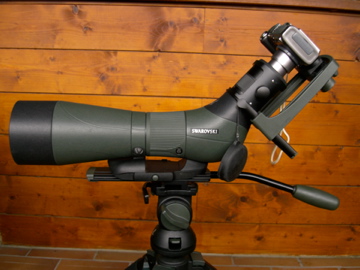
Swarovski ATM80HD scope, 25-50x wide zoom eyepiece, UCA digisoping adapter, Canon A590IS

Essentially, the UCA has been designed to mount either a compact digital camera or a DSLR. The camera screws on to a little base plate using the camera's tripod thread, and this clips on to the mounting platform. The camera can be unclipped and slid off the platform easily so that you can use it separately, and when you slide it back on it clicks back in to place and does not need readjusting before taking a photo.
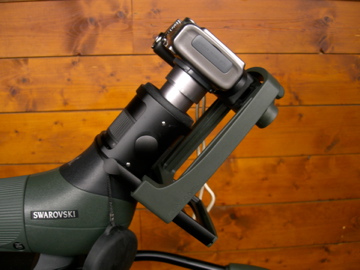
The UCA has the great advantage of allowing me to use it with my compact camera, a camcorder, or a DSLR. You can also take it off and put it back on quickly; separate the camera from the adapter easily (without need for readjustment when replacing); and always have easy access to the eyepiece's zoom. It is also rather light, which is an added bonus.

The new UCA has also come at a good time for my new interest in videoscoping. I'll post more videoscoping videos of birds over the next few weeks (including Longlegged Buzzard, Shorteared Owl, Himalayan Rubythroat, Pygmy Cormorants, Greater Flamingoes and much more).
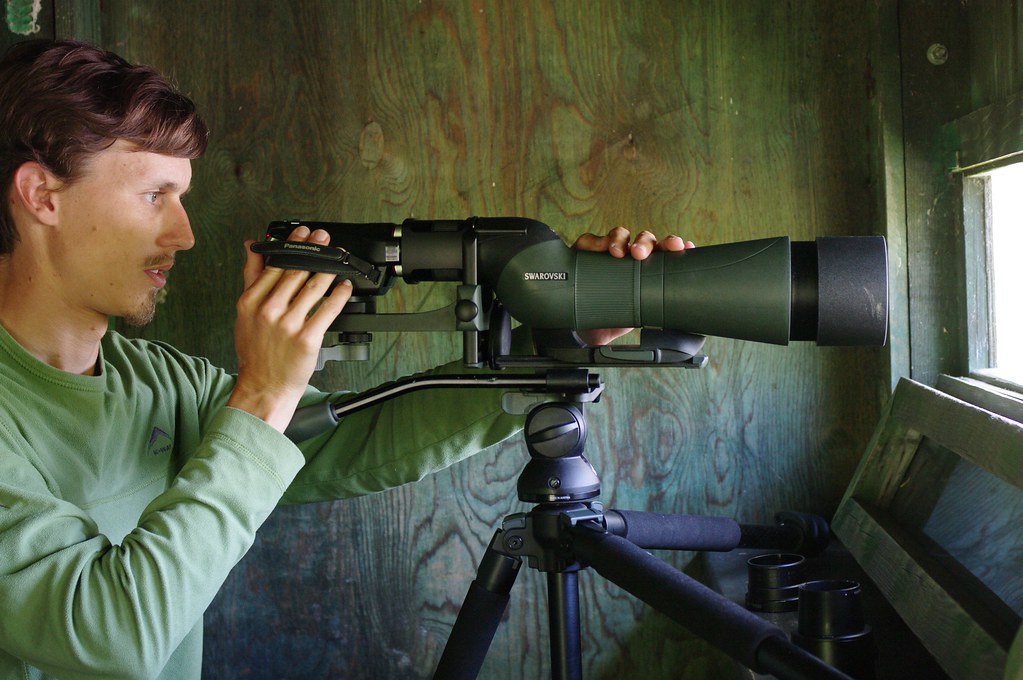
Videoscoping Pygmy Cormorants in Po Delta, Italy. Videoscoping setup is per digiscoping but with a Panasonic SD100 mounted on the UCA. Yes, that is a DCA on the counter.

I still use my DCA (the little ring digiscoping adapter you can see on the shelf in the hide photo, above), particularly if I know that I will be doing more observation birding than digiscoping, and if I have a pocket free. The DCA has the advantage of being small and pocketable when using a compact camera, but it does not fit all compact cameras because the camera needs to have a filter attachment thread/cone, and I don't find the scope's zoom as easy to use as with the other adapters.

DCA attachment of a DSLR. The DCA has the advantage of being small, light and easy to use, and works for many compact digital and DSLR camera. The disadvantage being that not all compact cameras have a filter adapter cone, and with a DSLR, the camera is only attached via the filter thread.

The DCA was one of the first digiscoping adapters introduced on the market and has quite a fan-base among DSLR users as it allows you to quickly slip the camera on and off again. The downside of this adapter (solved in the UCA) is that the camera is attached using the camera's filter thread, which was not designed to hold the weight of heavy DSLRs. Having said that, with a small 40 to 50mm "pancake lens", and a little bit of care, the DCA works like a dream, and along with the Telescope Rail to shift the centre of gravity further forward and balance the whole setup, it really does make DSLR digiscoping easy.

If you have the DCA ring attached to your DSLR (or even your compact camera), you can very easily use this for digibinning, by sliding the swarovski optik snapshot adapter on to your binoculars and then just using the DCA ring to cup over the snapshot adapter. This creates a good attachment platform for taking a quick digibinning photo.
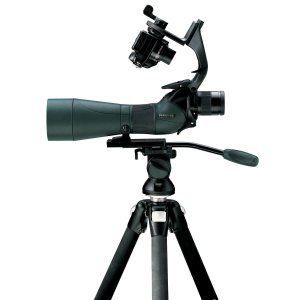
The DCB flips up and out of the way when using the scope for birding/observation.
The photo is off the internet somewhere 'cos I cannot find one of mine anywhere on my computer. Maybe someday I will replace it with one of my own photos.


I know that the DCA has its strong (and rather vocal) supporters, but with a compact camera, I frankly prefer my DCB. The DCB is a bracket that lets me flip my camera in front of the scope's ocular and then back out of the way again. The camera sits nice and neatly up above the scope. I can then use the quick-release slide on the Telescope Rail to balance the scope properly again. I think I like this system so much because it keeps the camera out of the way, but I don't have find a pocket or bag to hold the camera when I am not using it. This is a great advantage when hiking out somewhere and I don't want to have to take a bag (or clothing with big pockets) with.

The other thing I like about the DCB is that I can use my 30x wide or a zoom eyepiece with it (the current DCA can also do this, but you need to use a little elastic/rubber band or something to wrap around the 30xW to make it a little broader, to help the adapter get a snug connection).

I have heard some digiscopers voice concern about having their camara always exposed to beach sand, rain, etc. I have never had a problem with this. If it is starting to drizzle, I put my hat over the camera. If the conditions are too bad, you can always just unclip and slide the camera off of the DCB and put it somewhere waterproof or dry. Unfortunately, when you want to put it back on again, you will need to find the correct position again manually, but I have never found this too much of a hassle.

The one thing that I don't particularly like about the DCB digiscoping adapter is that the camera is easily bumped from position, i.e. swivelled out of place. This is particularly the case if your camera's tripod thread is offset from the center, meaning that the connection plate would attach to one side. It certainly helps to make sure that the attachment plate is screwed tightly in, but the other thing you can do is to try to make the attachment place a little more adhesive with some thin elastic bands or by glueing a little bit of sticky silicon in place. It doesn't help to be careful with your camera and digiscoping setup either ;-)

Happy digiscoping and happy birding!
Dale

p.s. if you are interested in digiscoping, then check out our Digiscoping Today meme.

Saturday, 9 May 2009

Tree Pipit videoscoped in Mieming, Tirol, Austria

So I now have a little HD videocamera to play with, so I hooked it up to my Swaro scope and took it out to play in the woodlands on the Mieminger Plateau (just above Telfs, west of Innsbruck). Being my first day videoscoping, I did not expect much, and it took a little while to get used to the whole setup. I'll write a review of the camera and setup when I get back from Kazakhstan.

At one stage, I flushes a pipit off the ground in an Austrian Black Pine woodland. Looks like a female Tree Pipit Anthus trivialis. She seems to be showing a brood patch which is why I am guessing it is a she.


Tree Pipit videoscoped in high definition using a Swarovski ATM80HD scope, a 25-50x zoom ocular eyepiece, the UCA adaptor, and a Panasonic SD100 camcorder.

I am pretty happy with the results, and it looks really great on my TV and computer. Unfortunately, I had to reduce the quality for YouTube, but it is still not too bad for my first time videoscoping birds.

Happy birding,
Dale Forbes

Night migration of birds - videoscoping

MoonWatch is an ornithological project aimed at investigating the night-time migration of birds through the Alps. It must have been almost a month ago now that we did the survey: spending each evening staring at the moon through a telescope looking for birds flying between us and the moon.

On two evenings, I did a little bit of videoscoping with my little point-and-shoot digital camera, the Canon A590IS. I put together a few clips with birds flying past the moon.


Can you see all four birds flying past the moon?

There are five clips. Only the last four have birds in them.
Congrats if you can see any of the birds in the small frame.
Viewing FULL SCREEN and in HIGH QUALITY definitely helps.

When you have found a bird, you can describe it in the comments section by saying which direction it is flying (top is 12, bottom is 6, like a clock face).

This will give you an idea of just how concentrated one needs to be in order to not miss a bird.

Happy birding
Dale

Monday, 9 March 2009

Alpine Accentor - early spring song (Tirol, Austria)

The Alpine Accentors have just returned to the high mountains of Tirol (Austrian Alps) and are really singing beautifully. I found this individual in the ski resort town of Kühtai (Sellraintal), just southwest of Innsbruck in Tirol, Austria. They are normally rather shy and tend to avoid human settlements during spring and summer, but this accentor was having a merry time singing from the terraces of the local hotels.


I took the video with my digiscoping setup (Canon 590IS; Swaro ATS 80HD, 30x eye-piece, DCA digiscoping adaptor) - hence the poor sound quality.

Despite the abundance of snow in the mountains (and even down in Innsbruck last night), it seems that spring is definitely on its way!

Happy birding
Dale Forbes