While I love this blog, I now pretty much only write on my other two blogs: BirdingBlogs.com and 10,000 Birds - I would love to see you there!
Showing posts with label Nutcracker. Show all posts

Saturday, 17 October 2009

Alpine Birding Spots 2 - Adolf Pichler Hütte / Kemater Alm


Lots of people that come to the Alpine Birds blog from google are - quite obviously - looking for info on Alpine Birds. And I love to talk about the places I love going birding. So I would like to try get a new blog series going about great birding spots in the Alps - well, at the the places that I like to go looking for birds, or just to appreciate nature. Here is the second one in the series:

Adolf Pichler Hütte / Kemater Alm


These two mountain huts lie just southwest of Innsbruck, but deep enough in the mountains to feel well away from civilization. Surrounded by stunning hills and the towering Kalkkögel Mountains, this quiet valley is a snow hole in winter and a lush green paradise in summer.

Summer time birding:
Entering the Senderstal (Sender Valley) from Grinzens (see map directions to birding spot here), you will need to buy a parking ticket at the machine at the entrance to the valley, just outside of town (€3, there is also a boom gate there). Have a look around in this area for Treecreeper, as well as Nuthatch and Crested Tit. Continue driving slowly up the valley road, following the little stream. On your way up through the forest, keep a look out for Three-toed Woodpeckers. They can be very shy, so it may take stopping the car for a bit and having a good (quiet) look about. The best place to do this is probably at the open parking area about half way up the valley (where you can leave your car parked for a bit and explore the forests). If you are lucky you may pick up a Greyheaded Woodpecker, a black grouse or a capercaille (but no guarantees on any of those!)

The drive up the valley follows the stream so you really want to find the local White-throated Dipper pair, and maybe a Grey Wagtail.


Kemater Alm and the stunning Kalkkögel Mountains

When you get to Kemater Alm (basically the first buildings you reach), you will need to park your car. You are now at 1646m (5400ft) above sea level. Take the trail along a gravel road (signposted to Adolf Pichler Hütte), heading straight for the stunning Kalkkögel Mountains. As you leave the farmhouse area, keep an ear and eye open for Willow Tits - they can be very abundant in the scrubby vegetation and sparce trees, particularly just south of the gravel road, and along the next 1 kilometer of road up towards the hut.

As you wander through the open alpine grasslands, look for the Water Pipit and groups of Alpine Accentors and Black Redstarts in the boulder-strewn areas.

As you get slightly higher up, scan the steeper rough ground for Whitewinged Snowfinch (they breed higher up but you have a decent chance of seeing them if you look really hard), and the cliffs for Wallcreeper. Always keep an eye in the sky and you might be treated with a Golden Eagle.


Field of Mountain Pine and open high alpine birding areas

Especially at migration time, the large areas of shrubby Mountain Pine (Latschenkiefer, Pinus mugo mugo) can be filled with life and one never knows what could be moving through. One day I will find a Siberian Warbler there!

The spotted nutcrackers are likely to be a permanent (or at least frequent) sound on your walk up. They typically spend alot of time in the Arolla Pines (Zirbelkiefer, Pinus cembra) - gnarly old trees that mostly grow right up between the forest and tree line.


An Arolla Pine, aka Spotted Nutcracker food!

When you get to Adolf Pichler Hütte, stop for a refreshing "Radler" (a beer shandy of Sprite mixed with beer) and some Kasknödel, eaten in a soup, with salad or Sauerkraut (a traditional cheese dumpling). Soak in that awesome view and enjoy!


After a bite to eat, head further up the hill, toward the ridge-line saddle behind the hut. At this point the path takes you down the other side back towards Kemater Alm (and you car), but what it is also wonderful to take a little stroll out along the ridge to the north. The view is stunning and well worth the 5minutes of extra effort ;-)


The lookout point at the end of the ridge

Note: if you do go out along the ridge line, you will need to back track to get back to the saddle and go down along the path to the west - you will not be able to get down directly from the ridge to Kematen Alm.

The path now takes you north along the western side of the little ridge. There is more vegetation here than on the trail up to Adolf Pichler Hütte, so your chances of picking up tits (especially Willow Tit) are rather high.

This valley appears to be an important migration path for Pipit, Fieldfares and other thrushes and at times there can be very large numbers moving through (esp. in on the autumn migration).

Winter time birding:

Park your car down in Grinzens and walk the road up the valley. The normal road becomes a Rodelbahn (sledding track) in wintertime, so you will not need any special equipment to go birding here in winter - just warm shoes and clothing.

As you wander up the road, keep a decent pace and listen out for bird parties. The tits in particular can be very vocal in winter and so the best way to find any birds at all is to simple try to find the tits. Once you have located some tits calling, scan every tree in the area for anything else. In the snowy forests, the birds form mixed species bird parties. These can be large and they are evidently very popular with our feathered friends because it is seldom that one sees too many birds outside one of these mixed species flocks. Favorite wintertime party participants include:
nuthatch (Kleiber)
crested tit (Haubenmeise), coal tit (Tannenmeise), great tit (Kohlmeise)
short-toed treecreeper (Gartenbaumläufer), eurasian treecreeper (Waldbaumläufer)
great spotted woodpecker (Buntspecht), three-toed woodpecker (Dreizehenspecht)
chaffinch (Buchfink)
robin (Rotkehlchen)
blackbird (Amsel)

the other rather vocal group are the Common Crossbills (Fichten-Kreuzschnabel) - they form large, noisy groups in winter and the males go bright red. they tend not to be as mobile or nomadic as in the rest of the year, as they oftentimes breed in winter (when the Spruce seeds ripen).


If you make it to Kemater Alm, have something warm to eat and drink and then head out behind the Alm towards Adolf Pichler Hütte (closed in winter) - you might pick up a Rock Ptarmigan or Whitewinged Snowfinch out on the snow fields. If you are thinking about going in to this area (especially in late winter/spring when both species are getting ready to breed), then first ask someone at the Kemater Alm about the avalanche risk. Snow Finches are wonderful, but not worth uncalculated risks.

Best time to go: Autumn (the colours are great)
Interesting bird species: White-throated Dipper, Spotted Nutcracker, Three-toed Woodpecker,Alpine Accentor, White-winged Snowfinch, Willow Tit, Golden Eagle.
How to get there: go to the google map, click on the first P(arking) symbol and say "to here". type in your starting location and google maps will do it all for you. Grinzens is approximately 20 minutes from the center of Innsbruck.


Happy birding,
Dale Forbes
Sunday, 22 March 2009

Aren't Birds Brilliant! - Birding with BirdLife

Last week, BirdLife employees from all over Europe had a meeting in Absam to workshop, learn and discuss the Aren't Birds Brilliant programme. For those of you who don't know what this BirdLife programme is all about, it is essentially about encouraging regular people to come out to particular natural history spectacles and experience some of the wonder and beauty that fascinates us as birders - it is about sharing our passion and love for all sorts of experiences Mother Nature has blessed us with.

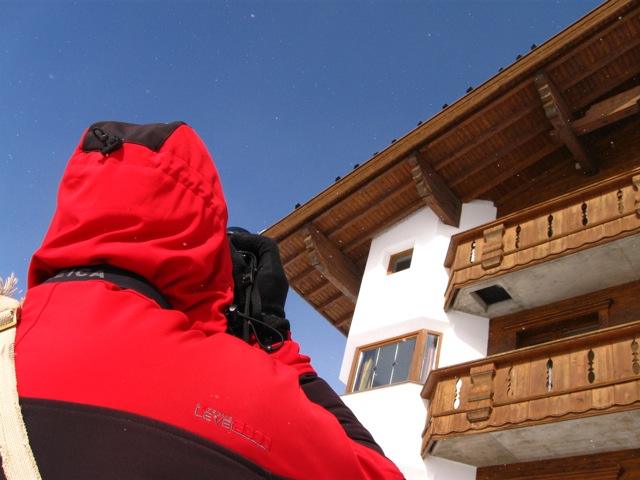
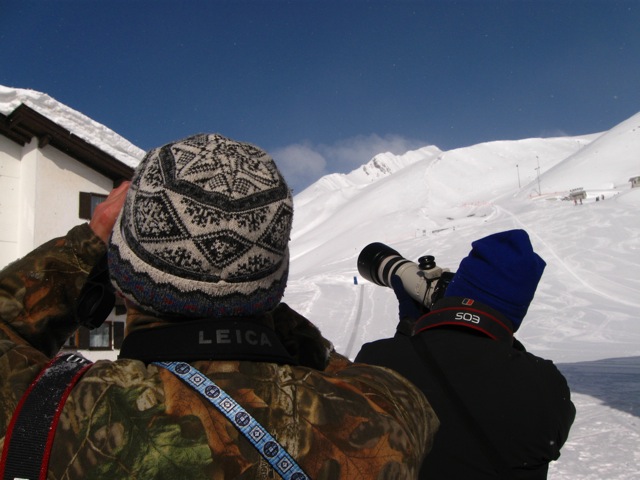
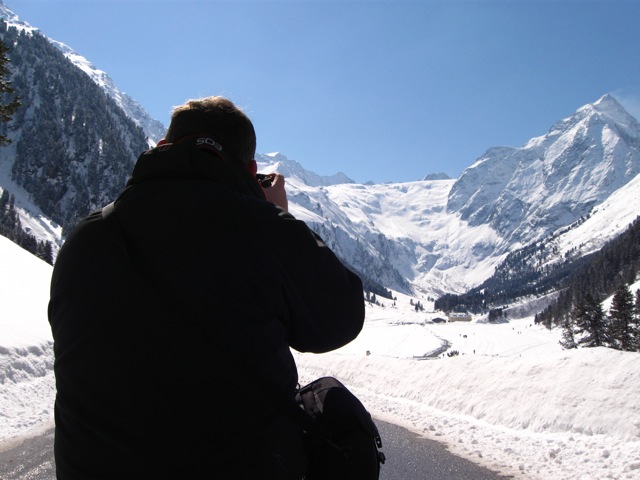
Marco Brodde (DOF Denmark) photographing Alpine Chough

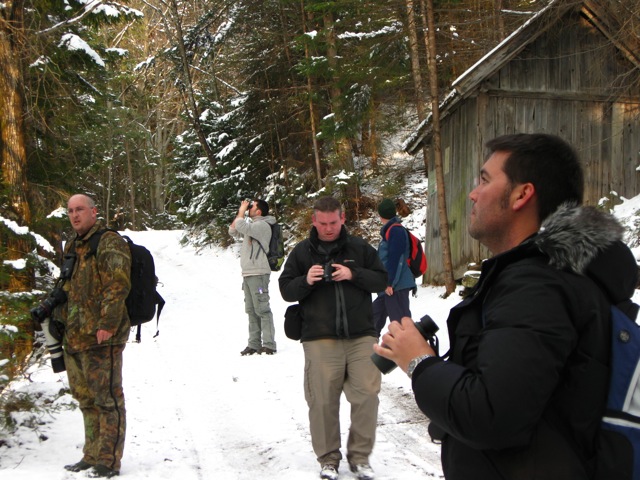
Anyhow, it is with this wonderful bunch of people that I got to spend Saturday with, showing them just how brilliant birding in the Alps of Tirol can be.

Our first stop was Kühtai. 2020m above sea level and 1.5m of snow. A real Alpine winter wonderland. But boy was it cold - about 10 degrees below freezing, with a biting breeze. But the escapade in to the mountains paid off quickly with a glimpse of a couple of Alpine Chough disappearing over the rooftops. Fairly quickly, we heard an Alpine Accentor singing from a balcony, affording us wonderful views. As we were watching the Alpine Accentor, a flock of Alpine Chough treated us by alighting on the rooftop.

Ken Smith (RSPB, UK) on the lookout...

Digiscoping Alpine Choughs in Kühtai

Digiscoping the singing Alpine Accentor in Kühtai

Heading off further in to town, we caught fleeting glimpses of the White-winged Snowfinches heading back to the area where they are fed with sunflower seeds. Getting back there, we managed to get incredibly views of a small flock of snowfinches feeding on the ground. It was great to get such a lovely look at such an beautiful and enigmatic Alpine bird species. The fact that 90+% of the birds had dark, black bills, and that there were only about 30 snowfinches about desipite the early hour and the light snow, suggests that they really have moved off to their high mountain territory areas.

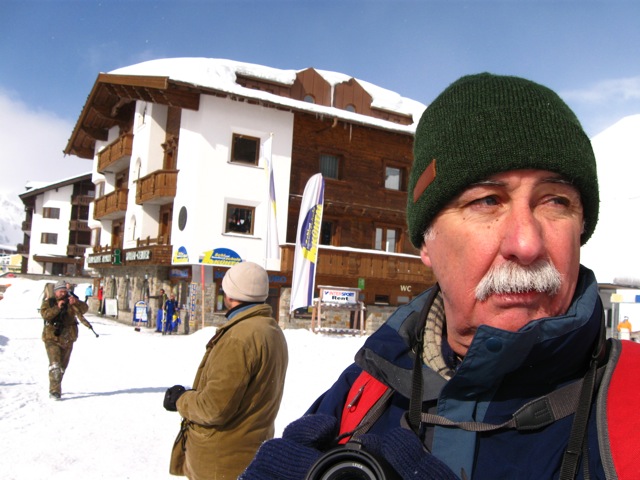
Orbán Zoltán (MME Hungary) and Mathew Capper (RSPB, UK) with the snowfinches

Heading back down the Sellraintal, I took the BirdLife group up to Lüsens for fantastic views of the Lüsenerfern Glacier. Besides the great views, we were hoping to pick up some of the other high-alpine species. Shockingly, the normally easily found Spotted Nutcracker did not want to be found (despite hearing them call a number of times). No sign of Ptarmigan, but wonderful views of a young Golden Eagle, and a dramatic fly-by by a huge white Northern Goshawk.

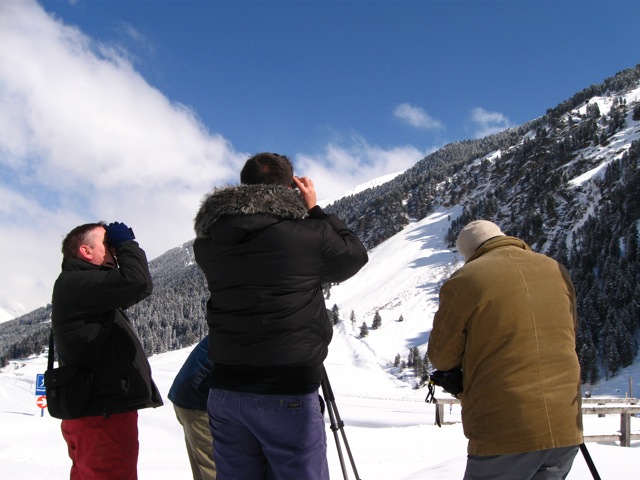
On the stake-out for Spotted Nuthatch.

Looking up at the Lüsener Fern Glacier.

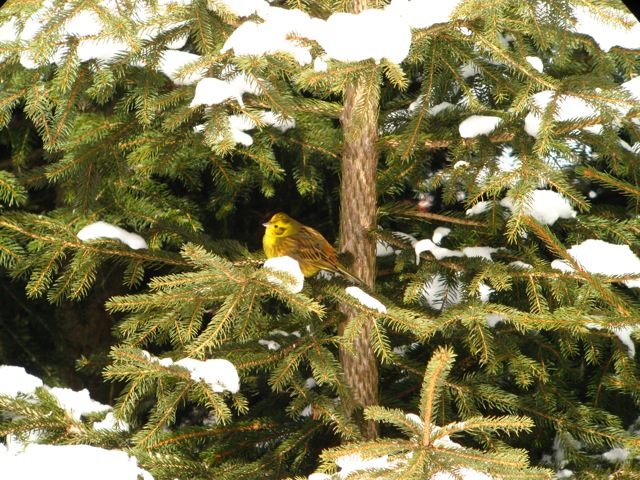
We then headed down to Juifenau, where we finally got good views of Nutcracker, and picked up Willow Tit, Coal Tit, Great Tit, Greenfinch, Nutcracker, Blackbird, and Yellow Hammer, all feeding in a garden on the outskirts of the little village.

Yellow Hammer in Juifenau.

On our way to Ehnbachklamm (the Wallcreeper stake-out), I saw some Chamois on the hillside near Martinswand and so wanted to stop for a couple of minutes so that the others can also see one of the Alps loveliest wild animals.
Fernando had a stern look on his face as he scanned the cliff behind the Chamois.
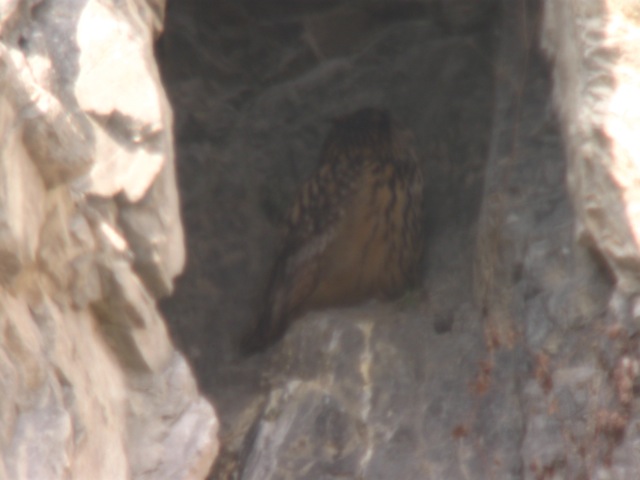
"The Eagle Owl is over there", he says.
No tonal inflection in voice.
Fixed action pattern reaction from birder. You can guess what it was.
"What?!"
A moment of silence as time bent.
And then, there it was. Sitting in a hole.
That made my day (and that of many others!)

Eagle Owl at 180x magnification

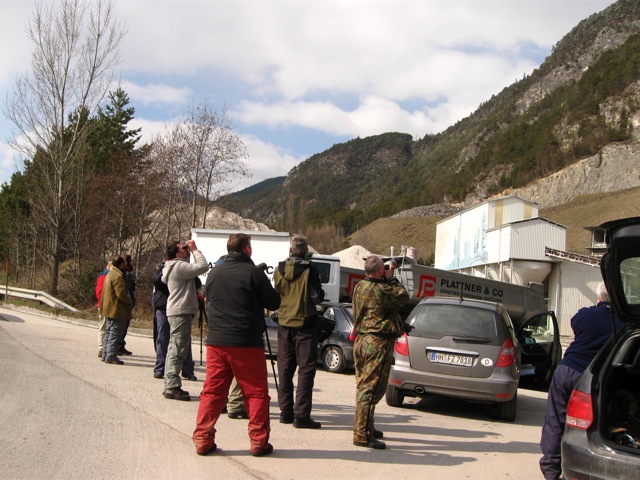
At the Eagle Owl stake-out

Leaving most of the group at Ehnbachklamm, Martin Capper (RSPB, UK) and I quickly dashed in to Innsbruck to get Joanna Kalinowska (OTOP, Poland) to the train station. There, we picked up a good 30 or so Crag Martins feeding over the Inn.

Joining the rest of the group in Ehnbachklamm, who had been searching for Wallcreeper, we learnt that the Wallcreepers were still playing hard to get.

We then headed out on a longer walk, hoping to pick up the shy Three-toed Woodpecker, Black Woodpecker and anything else we could come across. Heading all the way back to Brunntal Alm, we had plenty of time to soak in the peacefulness and beauty of the landscape. Three inches of fresh fluffy snow really gave the woodlands a lovely charm.


In the Brunntal area, Zirl

We ended the afternoon with a breath-taking view over Zirl, and the mountains to the south.

Life in the mountains is hard!

Happy birding
Dale Forbes

Sunday, 18 January 2009

Snowshoe tour in Tirol - Schlick 2000/Fulpmes in Stubaiertal

Schlick 2000 is a popular alpine skiing resort just outside of Innsbruck, Tirol, in the Stubaier Valley. The skiing is quite good - particularly in December and January with lots of natural half-pipe things for snowboarders and skiers to play around on. There are also a number of winter walking trails in the area and one trail designed especially for snowshoe walking. Yesterday, I decided to check it out.

Schlick 2000 parking lot in Fulpmes, I took the Gondola up to the middle station. From there, one heads out behind the ski school (to the north) and quickly gets in to the woods. The trail gently makes its way up through the woods and is very well sighnposted; orienteering - even after heavy snows - should be no problem whatsoever. I had thought that the skiers would detract from the walk, but they were far enough away for the trail to be very peaceful and wonderfully enjoyable.


View Larger Map

In the first half of the snowshoe trail, I came across a couple of Common Crossbill flocks, noisily feeding in the Norway Spruces (Picea abies) that dominate the woodland. Their German name - Fichtenkreuzschnabel - refers to their preference for spruce (Fichte) which pretty much sums up where you always tend to find them. The groups I came across were very vocal - I suppose they are probably getting ready to breed now while the spruce have an abundance of seed.

I also came across the occasional treecreeper (Baumläufer), some Coal and Great Tits and Nuthatches in the lower, denser forest. Well, maybe dense is not the best word to describe the forest there. In the lower sections of the trail, the canopy is fairly closed, but the heavy snow meant that the under-story was rather open and made it very easy to explore a bit off trail.


Further up the trail, the forest canopy thinned and eventually the forest petered out. Nearing the top of the trail, one is rewarded with great, big expansive views over the Stubaier and Wipp Valleys and their surrounding peaks. Taking a tea-break, I scanned the cliffs and peaks for Alpine Ibex and Golden Eagles without success. A pair of Spotted Nutcracker surveyed their lands from treetops at the edge of the tree line.


Reaching Schlicker Alm (1645m asl), you can enjoy some traditional Tirolean mountain food (and a beer ;-) before heading back down again. The return could be done back alone the trail you came up, but if you packed a Rutschblattl then getting down the sledding track is much faster and a whole lot of fun. I have no idea what I would call a Rutschblattl in English but it is this little plastic plate that you sit on, and a handle that comes up between your legs. It kinda looks like a miny, flimsy plastic shovel and is mainly a kids toy for sliding down little slopes. Anyhow, they cost almost nothing and weigh even less so are perfect for taking on snowshoe tours. Getting back down slopes (or sledding tracks) with a Rutschblattl is a whole lot easier than walking back down with snowshoes on! I have to say that maintaining complete control of the thing is probably never going to happen for me; your bum tends to take a few knocks; and they were not designed for high-speed toboganning but they are a whole lot of fun.

Happy birding (and snowshoe walking)
Dale

Saturday, 1 November 2008

Birding and the value of meeting with other birders

some friends and colleagues of mine are teaching a rather interesting MSc course at the local university at the moment about online branding. it sounded interesting so i joined in yesterday's class. one of the things we touched on was LAN Parties. For the uninformed, a LAN party is where a whole bunch of people get together - all with their own computers - and play games with each other. they sit right next to each other, play with each other, but only through the semi-isolated realm of their computers.

Why, might I ask would groups of people drag large, cumbersome computer equipment around so that they can be in the same room when the same could be done quite adequately using a high-speed internet connection? Something of a mystery.

But it did get me thinking, that even though many of our hobbies are well practiced alone (and might even be more productive and enjoyable alone), there is a collective enthusiasm and - dare I say - acceptance that comes from meeting with other like-minded and equally weird enthusiasts.

I was reminded of this last weekend when I got the opportunity to spend some time with some international birders (incl the super-digiscoper Clay Taylor). To put it in to context, birding in Tirol in not such a popular past-time. Granted, there are a good number of ornithologists about, and the locals love spending time in the mountains, but birding (and to a lesser extent, its more laid-back sibling, birdwatching) is rather unknown here. So, I tend to wander the mountains, forests and streams, all kitted out with tons of optical equipment, books, cameras (and sometimes the wife) with only a smattering of company from other bird enthusiasts. And it is sooo much harder to learn about the local avifauna alone than if one is surrounded by other crazed birders (my lovely wife is reading over my shoulder and told me that she can tell me where all the birds are. if ever I want to see a sparrow, she can help me out).

Birders: that group of mildly deranged individuals that will ignore a broken leg and infected wounds if they know that a new twitch has - some time in the possibly distant past - been seen in the area. Who of us would not swim across a crocodile infested river for a rare Pitta?
(and we tell ourselves things like: well, the only ones I've seen are less than 3m long and the locals say that it is only the bigger ones that eat people).

And so we all went out to a beautiful valley off of the Sellraintal (behind Haggen) to look for late Autumn Alpine remnants ... and saw almost nothing. But how great it was to go out with enthusiasts again - I left the weekend with tons of creative birding energy and an enthusiasm that is likely to stay with me well in to Winter. A couple of things that we did happen to see were: Alpine Chough (Alpendohle), Golden Eagle (Steinadler), Nutcracker (Tannenhäher) common here, but something interesting for the British and Dutch guys) and lots of very fat Chamoix (Gamsbok).

So, I guess my take home message is that being alone in the wilderness is awesome, but the enthusiasm and shared experiences and learning make trips with other birders priceless.

btw, the beautiful pitta image is of a Blue-winged Pitta taken by the talented photographer Myron Tay. Click on the image to link to his Flickr photostream.

Happy birding
Dale