While I love this blog, I now pretty much only write on my other two blogs: BirdingBlogs.com and 10,000 Birds - I would love to see you there!
Showing posts with label Common Buzzard. Show all posts

Tuesday, 3 March 2009

Well, the Alpine Accentors think its spring

I have not seen a single Alpine Accentor (Alpenbraunelle) in the many long months since the snows set in up in the mountains. I have looked for them.
And I have three theories:
  1. They have been super super shy,
  2. Alpine Accentors hibernate under the snow like Marmots, or
  3. Alpine Accentors move to slightly lower altitudes in winter (maybe Südtirol /Alto Adige in Italy).
After a good while with rather rough, stormy, snowy weather, we had a nice warming over the last few days. And as soon as the sun started to come out, the birds flew out in full song. Everywhere you went, there were tits singing, blackbirds chirping and common buzzards screeching.

Heading back up the Sellraintal to Kühtai, I expected to find the regular White-winged Snowfinches.
None.
Not a sausage.
It seems they are only about when the weather is rotten. and the warmer weather and spring feaver got them dashing off in to the mountains to set up their territories (many already have their breeding-colours black bill).

not finding any snowfinches and only a couple of Alpine Choughs early in the morning, I decided to go skiing for a while. The pistes were magical and soft. Off-piste there was a goog 60cm of fluffy soft powder snow. That kept me more than busy for a few hours.

Now that I think of it, I have kept my birder eye in the sky the whole winter, looking for a soaring Golden Eagle and not seen a single one! I wonder what has happened to them? Everything I have read says that Golden Eagles reamin in their territories through winter, but live in expanded home ranges. That means that - given the huge amount of time I spend watching nature and being in the mountains of Tirol - I should have seen at least one poor, cold, half-frozen Golden Eagle in that time. mmm

After playing in the powder snow for a good while, I decided to go for a little walk around the village of Kühtai to see what I could find. The village is actually pretty good year-round for finding high Alpine birds (and quite possibly my favorite alpine birding spot in Tirol).
Nothing.
As I was getting ready to leave, my cell phone rings.
I check my phone, but it is doing nothing.
Still, I hear the ring tone.
(I had, at one stage, an Alpine Accentor song as my ringtone)
So I scan the roof tops and quickly find the culprit.
A lovely singing Alpine Accentor on the roof above me.

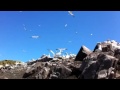
If you look really hard, you can see the Alpine Accentor at the apex of the roof.

I had my binoculars with me, and my camera, and tried my hardest to get a couple of digibinning photos of the Alpine Accentor, but it was just too far away to get anything decent. But at least you can see that it is an Alpine Accentor!


This is quite possibly a bird from the group that uses the little clump of trees just west of Kühtai (under the Dreiseenbahn Sesselbahn/chair lift).

Alpine Accentor feeding on some scraps on the ground

So, it seems that the Alpine Accentors are back and singing, and the White-winged Snowfinches are convinced it is almost breeding time - it must be spring!

For other blog entries (and lots more information) on Alpine Accentors, click here.

Happy birding
Dale Forbes

Thursday, 15 January 2009

Will shooting 250 raptors really help Lower Austria?

It seems the Lower Austrian (Niederösterreich) government - in their infinite wisdom - has decided that 250 raptors need to be shot in order to protect endangered species in the state. As far as I can tell, the official line is that there are 26 small animal species in the region that need protection and that 200 Common Buzzards (Mäusebussards) and 50 Northern Goshawks (Habicht) need to be shot by the end of January 2009 in order to protect these endangered species.

So much of this story just gets to me. I try to be calm and rational. But this just blows my top!

The WWF Austria page on the raptor shooting decree states, "There is no scientific evidence that either Common Buzzard or Northern Goshawks are a threat to any of the 26 [endangered] species mentioned in the decree. In fact, there is no evidence of either of the raptor species even preying on 16 of the cited species." (my rough translation)

This - to me - strongly suggests that there is some other interest at play that is not driven by conservation of endangered species. At the very least, this flies in the face of what conservation thought has said for at least 60 years - killing predators does not help conservation! and is the type of thinking that dominated hunting circles in the 19th century and before. Hunters were - undoubtedly - at the forefront of conservation and we have visionary hunters like ex-US President Theodore Roosevelt to thank for national parks, conservation action and protected wilderness areas. But ever since Aldo Leopold and his contemporaries, conservation thought has been led by the idea of thinking in terms of ecosystems. Aldo Leopolds "Thinking like a Mountain" writings are so beautiful and insightful, that I posted a piece of his writing in my earlier blog (it should be just below this one). In this article, Aldo Leopold speaks of the predator-killing mentality of previous times; when hunters (and park rangers) would always shoot at predators because they were seen as vermin that threaten the deer and so threaten the beauty and naturalness of the area. They were - in short - unwanted pests that should, in a perfect world, not be there. But, it was a close encounter with a dying wolf that opened Aldo's heart and helped him see how the wolves were an integral and crucial part of the ecosystem.

In the article "Wolves and Deforestation - Thinking like a Mountain", Aldo Leopold stresses how too many deer eventually harm the ecosystem. Hunters here will tell you that they shoot enough deer here so that their numbers do not get too large and, consequently, we do not need wolves or bears or lynx in the Austrian / Tirolean forests. That these predators are dangerous and life without them is better.
This makes me want to cry.
For we cannot know the intricacies of how predators affect change on deer populations and entire ecosystems. But more importantly, there is a power, beauty and majesty that great animals bring to open spaces. (but, at least we still have the Golden Eagles! ;-)

Shooting Buzzards and Goshawks to protect endangered species they do not eat is as ludicrous as shooting Alpine Brown Bears to protect the Ibex!

A few other arguments I have come across against the shoot include:
  1. the shoot is likely to be uncontrolled (or uncontrollable) and so many other raptor species (Saker Falcon, Imperial Eagles, White-tailed Eagles, Hen Harrier/Northern Harrier, Peregrine Falcon, Rough-legged Buzzard...) are likely to be "erroneously" shot.
  2. a Winter shoot would include many birds that are just over-wintering in the area and have joined us from elsewhere
  3. many of the endangered species in question are - at the moment - either on holiday in the tropics or hibernating
(Jos Stratford makes some good points on birdforum here)

If you are interested in seeing WWF Austria's English summary, click here, and feel free to sign their petition.


Happy birding
Dale Forbes

Wednesday, 14 January 2009

Snow shoe birding in the Alps / Tirol

Christmas time saw great weather in the mountains - we had had fresh snow just before Christmas and lots of blue skies since. I tried to play in the snow every day - skiing, sledding, walking and - thanks to Father Chistmas - show shoe hiking.


It really is wonderful to spend hours of quiet and solitude in the tranquil mountains. There is something about the woods in winter - there is a stillness that the snow brings that I can't quite describe. It is as though everything is holding its breath, waiting for something.

Just before New Year's, I took a hike from Axams to Axamerkogel. The forest down near Axams was alive with life. Well, maybe not dripping with life, but pretty cool for winter birding at least. What I have noticed is that one can walk for long periods of time without hearing one little peep from a bird and not seeing anything anywhere, and then suddenly you stumble upon a mixed-species bird party. It seems that the birds form the roaving groups that can have as many as a dozen bird species in them, all feeding together. Common winter party-goers include Coal Tits, Great Tits, groups of Firecrests, Eurasian and Short-toed Treecreepers, and Eurasian Nuthatches (Tannenmeisen, Kohlmeisen, Wintergoldhänchen, Waldbaumläufer, Gartenbaumläufer, Kleiber). Sometimes one of the other tit species will join - Crested Tits, Blue Tits (Habenmeisen, Blaumeisen). The Long-tailed Tits seem to join these mixed-species feeding parties occassionally, but their association seems to be a lot more loose: groups of five/six Long-tailed Tits will move around foraging together, join a foraging party for a while, and then slowly drift off in their own direction...

Heading out of Axams in the morning, I saw a flash of a raptor (looking very Accipiter-like) through the trees but did not get a good enough look to make an ID. Later on, coming down the mountain, a beautiful, big female Northern Goshawk rushed through the trees overhead (Habicht). So the other, smaller Accipiter was probably the male.

I have seen a few Northern Goshawks lately - always deep in the forests and always rather shy. But lovely to see nonetheless.

The raptor life here is - at the moment - dominated by tons of Common Buzzards (Mäusebussards). Everywhere we go, we see them circling overhead, sitting in the fields and peering out from their telephone-pole lookouts. The Common Kestrels continue to pester the pigeons in town.

I have seen very few Golden Eagles recently. Their daily range is much increased in Winter and this may have something to do with it. But, a couple of times I have seen them right down low in the valleys - and on one occassion we even saw a pair circling over the Inn between Kematen and Zirl. It is very unusual to see them so low down. I wonder what they were doing...?

Winter might not be the most exciting time for birding in the Alps, but the beauty of the forest and mountains certain keep one entertained between birds!

Happy birding
Dale Forbes

Thursday, 8 January 2009

winter birding and Christmas time in Tirol

I know, I know, I haven't written anything about birds or birding in ages. I have actually been doing quite a lot of birding recently - quiet walks in the forests, and snowshoe tours in the mountains. There are very few birds about, but the stillness and beauty of the forests makes for a lovely time.

Hopefully, I'll get back in to it in the next few days - there is plenty to talk about (always is when you are interested in birds...).

Had a Golden Eagle pair circling between Zirl and Kematen, over the River Inn the other day - spectacular sighting with the pair soaring tightly together (and dwarfing the Common Buzzards that were about). It was really special to see them just a few hundred meters from our house, and all the more because they were right in the middle of the Inntal.

The Eagle Owls (Uhus) should start displaying soon, so I will probably spend some bitterly cold evenings up in the mountains nearby looking for them.

bis bald
Dale

Sunday, 16 November 2008

Definately heading in to Winter

Birding here is proving a little tough. I got back from the World Travel Market (London's huge travel trade fair) on Friday and headed out in to the mountains this afternoon to see what we could see. The birds were quiet. So quiet. Not a peep.

But the mountains were stunning in the stillness.


My father-in-law and I went for a walk up the Vomperloch towards Gan-Alm, just North of Schwaz. The beauty of this spot is that it very quickly gets one in to the Karwendel park and away from the development and people of the Inn River Valley. Within a few minutes of walking, one is surrounded by peaceful mixed coniferous woodland and beautiful mountain peaks.

The European Beech (Fagus sylvatica, Rotbuche) and the European Larch (Larix decidua, Europäische Lärche) have already lost their leaves and added a red/brown hue to the forest floor and a sharp chill in the air would not let us forget that Winter was well on its way. The few birds we did see included Common Buzzards (Buteo buteo, Mäusebussard), Carrion Crow (Corvus corone corone, Rabenkrähe), Coal Tit (Periparus ater, Tannenmeisen), and a single Nutcracker (Nucifraga caryocatactes, Tanenhäher). Not even a single woodpecker called.


Late in the evening we saw a group of five Chamois (Rupicapra rupicapra rupicapra, Gämse).

So, the birds were not that spectacular, but the beauty of the landscape and the refreshing Alpine air certainly make a walk in Tirol's mountains worthwhile.

Happy birding
Dale

Monday, 29 September 2008

Late Autumn migration over the Alps

last week we went out to the Sattelberg, a gorgeous mountain overlooking the Brenner Pass, and split between Austrian and Italian territory. The mission was to try count birds migrating South over the ridge line.


We knew we were unlikely to see too many birds migrating through so late in the season, and the birds that were migrating were - I suppose - more likely to have gone straight up the Wipptal and over the Brenner Pass than to head all the way up and over the mountain top. At any rate, we braved the snow and winds to see what we could see.

As it turns out, we saw a good number of juvenile House Martins (Mehlschwalben) flying about (rather unusual for Tirol) but they all seemed to be heading North. Maybe we should have provided them with a map.


Also interesting was the large numbers of pipts moving through. They were unusually shy and quickly moved on. It looked like they were migrating in a boulder-to-boulder manner (rather than the rapid, directed flights that come to mind when we think of migration). The only species we were able to positively identify was the water pipit (Bergpiper), but we suspect there were a good few more about.

The only raptors we saw was one young Hobby Falcon (Baumfalke) which circled and flew directly over us, and a Common Buzzard (Mäusebussard).

View of Sattelberg from Gries am Brenner

Although we did not see too much, it was a lovely day to be out in the mountains. The Tirolean mountains really have something special to them.
A peace.
A wonder.
It is always special to be in them...


Happy birding
Dale