While I love this blog, I now pretty much only write on my other two blogs: BirdingBlogs.com and 10,000 Birds - I would love to see you there!
Showing posts with label Golden Eagle. Show all posts

Monday, 5 October 2009

Grossglockner National Park, Austria

I spent the latter part of last week and the weekend in Pörtschach am Wörtersee in Carinthia (Kärnten) - that's the next state across from us to the southeast - at the Tagung der TOG (Deutsche Ornithologen Gesellschaft). I suppose one could translate that as the Congress of the German Ornithologists' Society.

That was pretty cool, and I will post about it during the week, but now I most want to talk about the stunning drive home.

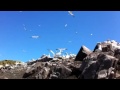
I took a route back through the Grossglockner National Park, an alpine wonderland with tons to experience. Stopping along the road, I went for a walk to soak in the beauty.


Here's a young Golden Eagle that came to keep me company


Happy birding!
Dale Forbes

Sunday, 18 January 2009

Snowshoe tour in Tirol - Schlick 2000/Fulpmes in Stubaiertal

Schlick 2000 is a popular alpine skiing resort just outside of Innsbruck, Tirol, in the Stubaier Valley. The skiing is quite good - particularly in December and January with lots of natural half-pipe things for snowboarders and skiers to play around on. There are also a number of winter walking trails in the area and one trail designed especially for snowshoe walking. Yesterday, I decided to check it out.

Schlick 2000 parking lot in Fulpmes, I took the Gondola up to the middle station. From there, one heads out behind the ski school (to the north) and quickly gets in to the woods. The trail gently makes its way up through the woods and is very well sighnposted; orienteering - even after heavy snows - should be no problem whatsoever. I had thought that the skiers would detract from the walk, but they were far enough away for the trail to be very peaceful and wonderfully enjoyable.


View Larger Map

In the first half of the snowshoe trail, I came across a couple of Common Crossbill flocks, noisily feeding in the Norway Spruces (Picea abies) that dominate the woodland. Their German name - Fichtenkreuzschnabel - refers to their preference for spruce (Fichte) which pretty much sums up where you always tend to find them. The groups I came across were very vocal - I suppose they are probably getting ready to breed now while the spruce have an abundance of seed.

I also came across the occasional treecreeper (Baumläufer), some Coal and Great Tits and Nuthatches in the lower, denser forest. Well, maybe dense is not the best word to describe the forest there. In the lower sections of the trail, the canopy is fairly closed, but the heavy snow meant that the under-story was rather open and made it very easy to explore a bit off trail.


Further up the trail, the forest canopy thinned and eventually the forest petered out. Nearing the top of the trail, one is rewarded with great, big expansive views over the Stubaier and Wipp Valleys and their surrounding peaks. Taking a tea-break, I scanned the cliffs and peaks for Alpine Ibex and Golden Eagles without success. A pair of Spotted Nutcracker surveyed their lands from treetops at the edge of the tree line.


Reaching Schlicker Alm (1645m asl), you can enjoy some traditional Tirolean mountain food (and a beer ;-) before heading back down again. The return could be done back alone the trail you came up, but if you packed a Rutschblattl then getting down the sledding track is much faster and a whole lot of fun. I have no idea what I would call a Rutschblattl in English but it is this little plastic plate that you sit on, and a handle that comes up between your legs. It kinda looks like a miny, flimsy plastic shovel and is mainly a kids toy for sliding down little slopes. Anyhow, they cost almost nothing and weigh even less so are perfect for taking on snowshoe tours. Getting back down slopes (or sledding tracks) with a Rutschblattl is a whole lot easier than walking back down with snowshoes on! I have to say that maintaining complete control of the thing is probably never going to happen for me; your bum tends to take a few knocks; and they were not designed for high-speed toboganning but they are a whole lot of fun.

Happy birding (and snowshoe walking)
Dale

Thursday, 15 January 2009

Will shooting 250 raptors really help Lower Austria?

It seems the Lower Austrian (Niederösterreich) government - in their infinite wisdom - has decided that 250 raptors need to be shot in order to protect endangered species in the state. As far as I can tell, the official line is that there are 26 small animal species in the region that need protection and that 200 Common Buzzards (Mäusebussards) and 50 Northern Goshawks (Habicht) need to be shot by the end of January 2009 in order to protect these endangered species.

So much of this story just gets to me. I try to be calm and rational. But this just blows my top!

The WWF Austria page on the raptor shooting decree states, "There is no scientific evidence that either Common Buzzard or Northern Goshawks are a threat to any of the 26 [endangered] species mentioned in the decree. In fact, there is no evidence of either of the raptor species even preying on 16 of the cited species." (my rough translation)

This - to me - strongly suggests that there is some other interest at play that is not driven by conservation of endangered species. At the very least, this flies in the face of what conservation thought has said for at least 60 years - killing predators does not help conservation! and is the type of thinking that dominated hunting circles in the 19th century and before. Hunters were - undoubtedly - at the forefront of conservation and we have visionary hunters like ex-US President Theodore Roosevelt to thank for national parks, conservation action and protected wilderness areas. But ever since Aldo Leopold and his contemporaries, conservation thought has been led by the idea of thinking in terms of ecosystems. Aldo Leopolds "Thinking like a Mountain" writings are so beautiful and insightful, that I posted a piece of his writing in my earlier blog (it should be just below this one). In this article, Aldo Leopold speaks of the predator-killing mentality of previous times; when hunters (and park rangers) would always shoot at predators because they were seen as vermin that threaten the deer and so threaten the beauty and naturalness of the area. They were - in short - unwanted pests that should, in a perfect world, not be there. But, it was a close encounter with a dying wolf that opened Aldo's heart and helped him see how the wolves were an integral and crucial part of the ecosystem.

In the article "Wolves and Deforestation - Thinking like a Mountain", Aldo Leopold stresses how too many deer eventually harm the ecosystem. Hunters here will tell you that they shoot enough deer here so that their numbers do not get too large and, consequently, we do not need wolves or bears or lynx in the Austrian / Tirolean forests. That these predators are dangerous and life without them is better.
This makes me want to cry.
For we cannot know the intricacies of how predators affect change on deer populations and entire ecosystems. But more importantly, there is a power, beauty and majesty that great animals bring to open spaces. (but, at least we still have the Golden Eagles! ;-)

Shooting Buzzards and Goshawks to protect endangered species they do not eat is as ludicrous as shooting Alpine Brown Bears to protect the Ibex!

A few other arguments I have come across against the shoot include:
  1. the shoot is likely to be uncontrolled (or uncontrollable) and so many other raptor species (Saker Falcon, Imperial Eagles, White-tailed Eagles, Hen Harrier/Northern Harrier, Peregrine Falcon, Rough-legged Buzzard...) are likely to be "erroneously" shot.
  2. a Winter shoot would include many birds that are just over-wintering in the area and have joined us from elsewhere
  3. many of the endangered species in question are - at the moment - either on holiday in the tropics or hibernating
(Jos Stratford makes some good points on birdforum here)

If you are interested in seeing WWF Austria's English summary, click here, and feel free to sign their petition.


Happy birding
Dale Forbes

Wednesday, 14 January 2009

Snow shoe birding in the Alps / Tirol

Christmas time saw great weather in the mountains - we had had fresh snow just before Christmas and lots of blue skies since. I tried to play in the snow every day - skiing, sledding, walking and - thanks to Father Chistmas - show shoe hiking.


It really is wonderful to spend hours of quiet and solitude in the tranquil mountains. There is something about the woods in winter - there is a stillness that the snow brings that I can't quite describe. It is as though everything is holding its breath, waiting for something.

Just before New Year's, I took a hike from Axams to Axamerkogel. The forest down near Axams was alive with life. Well, maybe not dripping with life, but pretty cool for winter birding at least. What I have noticed is that one can walk for long periods of time without hearing one little peep from a bird and not seeing anything anywhere, and then suddenly you stumble upon a mixed-species bird party. It seems that the birds form the roaving groups that can have as many as a dozen bird species in them, all feeding together. Common winter party-goers include Coal Tits, Great Tits, groups of Firecrests, Eurasian and Short-toed Treecreepers, and Eurasian Nuthatches (Tannenmeisen, Kohlmeisen, Wintergoldhänchen, Waldbaumläufer, Gartenbaumläufer, Kleiber). Sometimes one of the other tit species will join - Crested Tits, Blue Tits (Habenmeisen, Blaumeisen). The Long-tailed Tits seem to join these mixed-species feeding parties occassionally, but their association seems to be a lot more loose: groups of five/six Long-tailed Tits will move around foraging together, join a foraging party for a while, and then slowly drift off in their own direction...

Heading out of Axams in the morning, I saw a flash of a raptor (looking very Accipiter-like) through the trees but did not get a good enough look to make an ID. Later on, coming down the mountain, a beautiful, big female Northern Goshawk rushed through the trees overhead (Habicht). So the other, smaller Accipiter was probably the male.

I have seen a few Northern Goshawks lately - always deep in the forests and always rather shy. But lovely to see nonetheless.

The raptor life here is - at the moment - dominated by tons of Common Buzzards (Mäusebussards). Everywhere we go, we see them circling overhead, sitting in the fields and peering out from their telephone-pole lookouts. The Common Kestrels continue to pester the pigeons in town.

I have seen very few Golden Eagles recently. Their daily range is much increased in Winter and this may have something to do with it. But, a couple of times I have seen them right down low in the valleys - and on one occassion we even saw a pair circling over the Inn between Kematen and Zirl. It is very unusual to see them so low down. I wonder what they were doing...?

Winter might not be the most exciting time for birding in the Alps, but the beauty of the forest and mountains certain keep one entertained between birds!

Happy birding
Dale Forbes

Thursday, 8 January 2009

winter birding and Christmas time in Tirol

I know, I know, I haven't written anything about birds or birding in ages. I have actually been doing quite a lot of birding recently - quiet walks in the forests, and snowshoe tours in the mountains. There are very few birds about, but the stillness and beauty of the forests makes for a lovely time.

Hopefully, I'll get back in to it in the next few days - there is plenty to talk about (always is when you are interested in birds...).

Had a Golden Eagle pair circling between Zirl and Kematen, over the River Inn the other day - spectacular sighting with the pair soaring tightly together (and dwarfing the Common Buzzards that were about). It was really special to see them just a few hundred meters from our house, and all the more because they were right in the middle of the Inntal.

The Eagle Owls (Uhus) should start displaying soon, so I will probably spend some bitterly cold evenings up in the mountains nearby looking for them.

bis bald
Dale

Tuesday, 9 December 2008

Birding in eastern Austria: Neusiedlersee, Lange Lacke and others

Last weekend, on our way back in from Hungary, Martin Riesing took me on a whirlwind tour of Burgenland / eastern Austria's best birding spots. We went in search of hawks and saw tons of Hen Harriers (Circus cyaneus, Kornweihen), an immature White-tailed Eagle (Haliaeetus albicilla, Seeadler), an Imperial Eagle (Aquila heliaca, Östlicher Kaiseradler) and a few Kestrels (Turmfalken) but no sign of the Saker Falcons (Falco cherrug, Sakerfalke).

A quick detour to find Great Bustards (Otis tarda, Großtrappe) produced a healthy flock of individuals flying together - I had never seen anything like it: 18kg birds flying. Sure, I had seen a good number of Kori Bustards (Ardeotis kori) in southern Africa, but they very rarely take to the skies and I had only ever seen them in pairs - never in a whole flock of scores of them!


The climax of the day was spending a few hours bracing against the bitterly cold wind along the shore of Lange Lacke, where we saw thousands of Greylag and White-fronted Geese (Anser anser and Anser albifrons), a good few Bean Geese (Anser fabilis, Saatgans), a couple of Barnacle Geese (Branta leucopsis, Weißwangengans), and - the highlight for me - a single Red-breasted Goose (Branta ruficollis, Rothalsgans) moving about with the White-fronted Geese. We tried our best, but could not find a single Lesser White-fronted Goose (Anser erythropus, Zwerggans).

Birding in eastern Austria is obviously quite different from birding here in the Alpine region of western Austria - and there are certainly lots more species to be seen - but I must admit that by the end of the weekend I was itching to get back to the mountains to see some of our alpine birds again - Alpine Accentors, Snow Finches, Golden Eagles...

Happy birding
Dale

Saturday, 1 November 2008

Birding and the value of meeting with other birders

some friends and colleagues of mine are teaching a rather interesting MSc course at the local university at the moment about online branding. it sounded interesting so i joined in yesterday's class. one of the things we touched on was LAN Parties. For the uninformed, a LAN party is where a whole bunch of people get together - all with their own computers - and play games with each other. they sit right next to each other, play with each other, but only through the semi-isolated realm of their computers.

Why, might I ask would groups of people drag large, cumbersome computer equipment around so that they can be in the same room when the same could be done quite adequately using a high-speed internet connection? Something of a mystery.

But it did get me thinking, that even though many of our hobbies are well practiced alone (and might even be more productive and enjoyable alone), there is a collective enthusiasm and - dare I say - acceptance that comes from meeting with other like-minded and equally weird enthusiasts.

I was reminded of this last weekend when I got the opportunity to spend some time with some international birders (incl the super-digiscoper Clay Taylor). To put it in to context, birding in Tirol in not such a popular past-time. Granted, there are a good number of ornithologists about, and the locals love spending time in the mountains, but birding (and to a lesser extent, its more laid-back sibling, birdwatching) is rather unknown here. So, I tend to wander the mountains, forests and streams, all kitted out with tons of optical equipment, books, cameras (and sometimes the wife) with only a smattering of company from other bird enthusiasts. And it is sooo much harder to learn about the local avifauna alone than if one is surrounded by other crazed birders (my lovely wife is reading over my shoulder and told me that she can tell me where all the birds are. if ever I want to see a sparrow, she can help me out).

Birders: that group of mildly deranged individuals that will ignore a broken leg and infected wounds if they know that a new twitch has - some time in the possibly distant past - been seen in the area. Who of us would not swim across a crocodile infested river for a rare Pitta?
(and we tell ourselves things like: well, the only ones I've seen are less than 3m long and the locals say that it is only the bigger ones that eat people).

And so we all went out to a beautiful valley off of the Sellraintal (behind Haggen) to look for late Autumn Alpine remnants ... and saw almost nothing. But how great it was to go out with enthusiasts again - I left the weekend with tons of creative birding energy and an enthusiasm that is likely to stay with me well in to Winter. A couple of things that we did happen to see were: Alpine Chough (Alpendohle), Golden Eagle (Steinadler), Nutcracker (Tannenhäher) common here, but something interesting for the British and Dutch guys) and lots of very fat Chamoix (Gamsbok).

So, I guess my take home message is that being alone in the wilderness is awesome, but the enthusiasm and shared experiences and learning make trips with other birders priceless.

btw, the beautiful pitta image is of a Blue-winged Pitta taken by the talented photographer Myron Tay. Click on the image to link to his Flickr photostream.

Happy birding
Dale

Monday, 20 October 2008

Autumn colours and mountain birding

Having lived all my life in the tropics or subtropics, I had never really experienced the wonder of northern hemisphere autumn colours. The splendour still enthralls me. Walking / casual birding around Adolf Pichler Hütte the weekend before last, the lovely reds in the grass, and a fine sugar-coating on the mountains made for a spectacular walk.

Birds were few, however, and besides a few willow tits (Weidemeisen) and flocks of Fieldfares (Wacholderdrossel), we did not see much.


Yesterday brought mildly better birding success. We spent the day exploring Kühtai and the Sellraintal for decent Autumn birding spots. We picked up a hunting Golden Eagle (Steinadler) on Kühtai's sunny slope, and a very shy three-toed woodpecker (Dreizehenspecht) behind Haggen bei Sankt Sigmund.


happy birding
Dale

Thursday, 29 May 2008

Golden Eagles


The sight of a Golden Eagle soaring by is a majestic one.
Incredible.
Breathtaking.


Coming in to spring, I have started to see more of these gorgeous eagles and I am not sure why exactly that is. So, with my curiosity piqued, and having access to some great academic reference libraries, I decided to try find out a little more about them.

The Golden Eagle (Aquila chrysaetos, Steinadler) has a fairly wide distribution through the Palaearctic and Nearctic (thanks wikipedia) and here in Central Europe, is associated with the high peaks and wilderness areas. As a youth, the Golden Eagle represented the awesomeness of nature: power, grace, freedom. And the Scottish Highlands. Of course, I have always wanted to see one: partly to see how they compared with the African eagles, but also for the more profound, spiritual connection I felt with them.

Okay, let me regale you with some cool things I managed to find out about Golden Eagles here in Europe: In northern Sweden, the distance between golden eagle nests was about the same for cliff and forest/tree nesting pairs, but still 100-170km apart! Wow! The author suggests that this nest spacing is more a factor of eagle spatial requirements than restrictions on the availability of nest sites (M Tjenberg 1985 Ibis 127/2). Now, the second statement kinda made sense to me, but 100-170km between nests! that is huge!

Well, I could understand this figure if the eagles were covering a large area, but in Spain, immature Golden Eagles (after juvenile dispersal) traveled an average of only 14km per day (range: 0.1 - 53.2 km) and only 2-6km per hour during peak activity (Soutullo, Urios & Ferrer 2006 Journal of Ornithology 147/1). This leads me to speculate that the Golden Eagles further South might not move as much as their Swedish counterparts and their nests might not be as widely dispersed. The same group of (Spanish) authors found that even young birds on juvenile dispersal moved only about 70 to 140km from the nest site (for males and females, respectively)(Soutullo, Urios, Ferrer & Peñarrubia 2006 Ibis 148/2). One female that was tracked from fledging, moved most in her first year (max 130km from nest, covering 16,000 km2, 95% of total range) and used only 40% of her total range in the remainder of the dispersal period (Urios, Soutullo, López-López, Cadahía, Limiñana & Ferrer 2007 Acta Ornithologica 42/2). She eventually settled in to a vacant territory just 26km from her natal site (Ibid).

So, my speculation was not too far off. I have just found a paper on Golden Eagle habitat use in northern Italy, where the mean distance between nests was 8.7km (Pedrini & Sergio 2001 Bird Study 48). This links with Haller's (1982 Orn. Beob. 79) findings in the Swiss Alps where the mean foraging area was only 41.8km2 (roughly a circle of 3.6km)

It seems that the eagles tracked by Soutullo et al (2006) had their peak activity between 11am and 6pm. I suppose this is why we see them so often at these times as they circle the peaks and ridges. So, if you are out hiking in the mountains, the sun is high in the sky, and the thermals are rising, keep an eye to the skies as one of these beauties may just glide by!


Happy birding,
Dale Forbes


p.s. I took the photos through my binoculars from Eppzirler hut, between Scharnitz and Zirl - for almost the whole time that we were at the hut, the pair circled the peaks, showing off for us!

Sunday, 13 April 2008

Yellow wagtails, grey wagtails and great big Golden Eagles!

I have always had an interest in wagtails. There is something about their nature that always caught my eye. That calm demeanour. And a ritualistically wagging tail. It is like looking at a monk calmly chanting his maha mantra. I remember being fascinated by the little cape wagtails that visited our garden as a child. Scoured every brook for a longtailed wagtail, and never failed to point out the odd pied wagtail. A little later, the pipits (basically ridiculously difficult to tell apart brown versions of wagtails) drew my attention.

This morning we went out on a joint walk with BirdLife Austria, and WWF to Schloss Tratzberg to walk about in the fields and stream-side habitats. Early on, we found a few cute little birds; some of my favorites being the european blackcap and the jackdaw. But when the sun started to rise in the sky, and the day started to "warm" up a bit (all relative of course - the snowy peaks do not lend themselves to warm mornings), the wagtails started to come out.

A gorgeous grey wagtail presented himself for examination alongside a little stream. Our competant guide Andreas Schwarzenberger regaled us with his trick to telling the grey from the yellow wagtail: "It's easy" he said "just look at the colour of their back." You see, both species are rather variable in their coloration but their back color is always rather constant: if it has a greenish or brownish back, it's a yellow wagtail, and if the back is grey then (you guessed it), it's a grey wagtail. Easy when you know how!

The day's highlight was, for me, two gorgeous golden eagles. Granted, I am prone to exageration. But these birds were absolutely incredible. They were way up, circling the peaks and they still looked impressively large. One of the birders had brought along his Swarovski telescope, affording us great views as they circled in and out of the morning mists. Previously, I had thought that they may be somewhat difficult to tell apart from other large raptors, but their distinctive eagle wing shape and their sheer size gave these guys away in a snap - keep a look out for the bulging trail edge to the wings (thanks Andreas!), and the enormous wingspan.

To add to the day's raptor tally, we also saw a couple of black kites (sorry, couldn't resist noting them here), a steppe buzzard and a pair of greater kestrels (being mobbed by the jackdaws).

All in all, a lovely morning.


Dale Forbes