While I love this blog, I now pretty much only write on my other two blogs: BirdingBlogs.com and 10,000 Birds - I would love to see you there!

Friday, 15 October 2010

Is it not enough to have your heart in the right place?


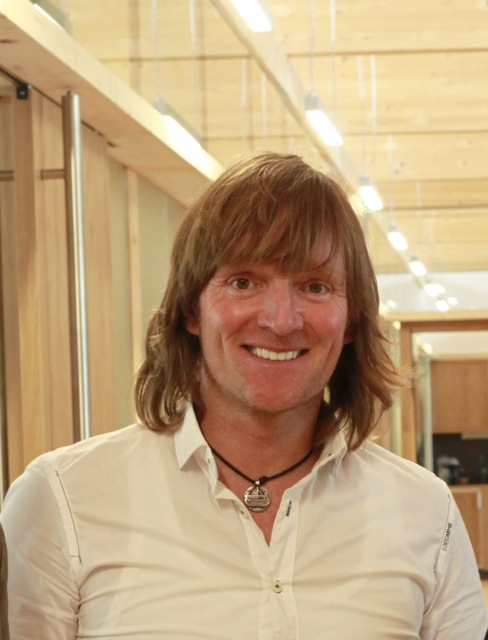
At the beginning of the year I got to meet Andreas Kieling, an absolutely fascinating man. How to describe him. I suppose wildlife film-maker is probably how he is described most often. But it is normally rather silly to try to sum complex people up by a description of their job, so I'll try to share something of what I felt of him. A complex man who, in person, is rather quiet and unassuming. But the man has spent such a huge amount of his time over the last 20 years just being in nature, that he is filled with an awe for nature. He oozes it. And people around him feel this and if you have any remote interest in our planet and her complexities, then you cannot help but being drawn in to his bubble of nature appreciation and adventure.


Now, I am quite certain that he is not perfect. His feet probably smell. And I would imagine he farts when he eats too much cabbage. He almost certainly has something about him that would annoy me. And if we ever spend enough time together we will find something to disagree on. With absolute certainty. 100%
Because neither of us are perfect.
When I reach the state of Buddhahood, or a complete understanding of Lord Jesus, I will be able to completely accept him as he is.

But the thing is, the man has such a deep love for nature, that I cannot imagine anything less than granting the man a great deal of respect and trying to accept him for who he is. On top of that, he has dedicated much of his life to not only understanding nature, but also to sharing his passion with others: to bring his appreciation and caring to a wide audience around the world.


So why am I blabbing on about Andreas Kieling and when am I going to get to saying something of remote relevance to my title?

In April, I made a little movie with Andreas Kieling in eastern Austria (Burgenland). We had gone out to photograph and film Great Bustards displaying, and what a sight that was! Crazy birds. Crazy crazy crazy.


Anyhow, so we put the movie on Youtube, along with some of the footage of the Great Bustards displaying taken through the spotting scope. It seems most people liked the video, until the other day some guy wrote a comment that offended me (and some of my colleagues). I mean, what is with people and critical, negative comments. So what if you do not personally like this man and the video and think someone else is better.
A (very) rough translation:
He's a 5 star farcical big-head. Played up and senseless drivel on every corner. This has nothing to do with serious documentation. I think Heinz Sielmann's documentaries are 1000 times better.
What would drive anyone to write this. I just cannot for the life of me figure this out. Heinz Sielmann has some wonderful documentaries too. This is not a serious documentary. Yup, yup. You do not like Andreas Kieling. Fine. But he has helped thousand (millions?) appreciate nature in a much stronger way (especially bears, his first love).
So, after sleeping on it, we wrote a softened response.

But I suppose this "problem" has been seen many many times before. I would imagine that most bloggers who have been doing it for a while have been through moments of self doubt, thinking about throwing in the towel. Because the thing about blogging is that we open ourselves up to the world. We lay our thoughts and hearts on paper and spread them open for the world to see. And sometimes there are people who take objection to that.

But please, if you think my feet are smelly or my ideas/videos/blog posts/photos/hair are silly, just mosey on over to another better smelling blog.

I love life. I love nature. the mountains. my family. birds. plants. blue skies. rain. mist. my job. digiscoping. art. sport. smiles. laughs. life. And I hope I am in some small way able to share my love for all that. And that it is in some small way contagious.

Happy days,
Dale Forbes


Sunday, 3 October 2010

Playing with the new Panasonic G2


We got the Panasonic Lumix G2 just a few weeks ago and the Photokina in Cologne was the first time I had a little bit of time to play with it and see what it could do.

To be brutally honest, I was not expecting much - something like a camera trying to be a real camera but not really living up to the promise. The Lumix G2 was a pleasant surprise.


The pictures here were all taken on my morning/evening walks between our hotel (near the stunningly beautiful Cologne cathedral), and the Photokina expo hall. The Hohenzollern Bridge is one of the most wonderful places I discovered in my (short) time in Cologne, 409m long (1350ft) and decorated with love padlocks (Liebesschlösse).


a really old lock. where on earth did they find this lock?

I loved playing with the light and colours on the bridge...

The masterkey...
I loved that


playing with artificial effects on the computer

new and old

Well, the Panasonic G2 is no Nikon D3, but I was quite happy with its ease of use, how quickly it was to find my way around the camera, and its control of depth of field, amongst other things. I'll be using this camera a whole lot over the next few months for it certainly seems to be more than a handy digiscoping camera.

Sunday, 26 September 2010

new Panasonic Lumix GH2 for Digiscoping

At the Photokina last week, I got to spend a good 1/2 hour with a pre-production model of the Panasonic Lumix GH2, and so got it on a UCA, behind a telescope to check it out for digiscoping.

The new Panasonic Lumix GH2, ready for digiscoping

The GH2 is Panasonic's latest mirror-less micro 4/3s system camera and features a 16MP 17.3x13.0mm sensor. I was not allowed to put my memory card in to the GH2, but looking at the images on the camera, the performance at 800 ISO was surprisingly good (better than the G2?) and certainly usable for most situations. Given that the sensor is smaller than the average DSLR's APS-C sensor, the camera needs less light to get a usable shutter speed, and it has no mirror flap, so this ISO800 is likely to be more than useful for digiscoping.

Showing off what the GH2 can do. Resolving absolutely incredibly tiny dots on a tin that was a good 10m away (just under the TV on the back wall, by the star. tin is about the size of the star). Swarovski ATM65 HD, 25-50x eyepiece, 45mm Objective, Panasonic GH2.

We tested 3 objectives on a Swarovski ATM65 HD with 25-50x wide-angle eyepiece:
- 20mm f1.7 pancake. no vignetting when eyepiece >28x.
- 45mm f2.8 Leica. no vignetting. exceptional resolution. expensive ($900)
- 3D objective 12.5mm f12.0. no vignetting above about 30x. Very interesting.

Jörg Kretzschmar admiring the new Panasonic GH2. I think he is stroking it. Jörg is one of the most incredible digiscopers I have ever come across. His work is like hot chocolate for the eyes. www.ozellus.de

So, what stood out about the GH2 for digiscoping?

1. 40 frames per second burst photo mode (great for action sequences)

2. Good autofocus.
Published figures claim 0.099secs - the equivalent of many a DSLR. I have found the G2 to be pretty quick (0.2s) and reliable in most situations, the GH2 contrast detect was looking pretty good in the dull, artificial light of the exhibition hall. The focus of the GH2 might, not be as quick as a good DSLR or - for that matter - does not come close to the shockingly quick autofocus of the new Sony a33 and a55 system cameras (which use beam-splitting phase detect autofocus), but these other cameras will not autofocus reliably through a spotting scope (I tried). The GH2 remains the quickest autofocus system for digiscoping I have come across.

3. Touch screen.
The GH2 seems to have exactly the same touch screen as the G2, a feature I have found more than just a gimmick (which is what I had initially passed it off as). Being able to tap your focal point (and having it followed!) can really be rather useful in a digiscoping situation to make sure you are focussing on the Red-breasted Goose and not the White-fronteds.

The first digiscoping photo with the Lumix GH2? on a Swarovski ATM65 HD.

4. Improved Electronic viewfinder.
EVF technology is developing quickly. At 1,533,600 dots, a 100% view and a magnification of 0,71% (Nikon D3 = 0,7x and Canon 1Ds = 0,76x), the GH2s electronic viewfinder looks good. It is still nowhere near an optical viewfinder, but it is likely to be rather useful for digiscoping when the sun is shining from unhelpful angles.

5. Full HD video.
I suppose many would have guessed by now how much I enjoy video digiscoping and how much fund I think it is. The ability to take full HD video (Motion Jpeg, AVCHD, AVCHD Lite Pal) at up to 50 fps is something that really stands out. External jacks allow for HDMI direct output
and input from an external microphone.

This camera is bound to be a lot of fun and if we had not just bought the Panasonic Lumix G2 (which I am coming to love), I would seriously think about this camera. Maybe at the end of the year...

First delivery: November 2010
Suggested Retail Price: €900 (without objective)

Happy digiscoping,
Dale Forbes

Monday, 13 September 2010

What Shutter Speed for Digiscoping?

Whilst in Thailand, we stayed on the edge of Khao Sok National Park (an absolute gem) where we had a banana flower visited by a number of different spiderhunter species. I had been meaning to make a video on shutter speed and digiscoping for a while, and this seemed like a perfect opportunity.


"All of my digiscoping photos are out of focus" is pretty much the most common thing that digiscopers say to me. This normally has very little to do with focus, and everything to do with camera shake. Camera shake is a killer, and shutter speed its blade.

Now in normal daylight conditions, pretty much anyone can take a half decent (sharp) photo with a digital camera. Just keep it on that little green square (full automatic mode), and away you go. As easy as that.

Digiscoping is something completely different. Focal lengths in digiscoping typically range from long (say 800mm) to the ludicrous (5000+ mm) and this brings with it a whole pile of issues. Professional telephoto photographers deal with these issues all the time and digiscoping is no different. It requires the digiscoper to commit time and energy to start to think more like a serious photographer. To understand what shutter speed, aperture, ISO and all those other fantastic things are all about.

So, what shutter speed do I need to get a good, sharp digiscoping photo?

This is, unfortunately, not a simple question to answer and depends on many factors including:
- type of camera (DSLR with a flapping mirror, or little compact camera?),
- how steady your setup and hand are (just had a Red Bull and espresso?)
- how much your subject is moving (tortoise or hare?), and
- luck (had to add that ;-)


DSLRs have a flapping mirror = need more shutter speed
As the name suggests, DSLRs have a mirror that flaps about all over the place. If you want to take a sharp photo with a flappy DSLR and a focal length of 1000mm, then you will need a shutter speed of a good 1/1000s. Which, unless it is a bright day, will mean that you will have to have a high ISO.
Here is a video on ISO in digiscoping:

DSLR on LiveView cuts out mirror flap.
A trick to use with modern DSLRs is that you can switch to LiveView and take a photo there without the mirror flapping, i.e. the only extra movement comes from the aperture blinking while taking the photo. At the moment, it only seems to be the Canon cameras that do this, which is one of the many reasons why I much prefer Canon DSLRs to the Nikons I have used recently (for digiscoping, that is. For general photography and telephoto photography, I find the Nikons just as nice).

Compact cameras shake less.
The much smaller blinking eye in compact cameras seems to produce much less vibration when taking a photo with a DSLR even on LiveView. This is why you can push the shutter speed even slower with a little compact and still have a chance of getting a half-way sharp photo.

More stability = need less shutter speed.
By making sure that there is as little shake in the entire system as possible, you effectively reduce the minimum shutter speed you need in order to get a sharp photo. This includes using things like a cable release, a countdown timer, a good tripod or bean bag, and avoiding wind:


A good dose of luck never hurt anyone.
Or, as Gary Player used to say, "the more I practice, the luckier I get". Practice, practice, practice. And take lots of photos, some will be keepers!

Happy digiscoping,
Dale Forbes

Saturday, 11 September 2010

Off to the Vogelfestival RUhr

It is very early in the morning and it still feels like yesterday, but I need to catch a transfer to the airport 'cos I am flying to Dortmund or Düsseldorf (can't remember which but I suppose my aeroplane will kick me off at the right place), and then up and off to the Vogelfestival Ruhr!

Vogelfestival Ruhr (Ruhr Bird festival) is on the Kemnader Dam, between Bochum and Witten in northern Germany and last year it attracted 5500 birdwatchers and ornithologists. I am really looking forward to it.

logo01.png


If you happen to be there, I will be the guy with the drowsy look on his face ;-)

Here is a video that Thomas made last year:

Happy birding,
Dale Forbes

Saturday, 4 September 2010

Rock Climbing Raileh / Prananga Beach

These have got to be some of the most spectacular cliffs I have ever experienced in my life. We stayed in Raileh East at the beginning of our trip, visiting Prananga Beach (the most stunning beach in the whole wide world) but never got around to climbing because we were too eager to get across to the Phi Phi Islands to go diving. Anyway, due to a somewhat embarrassing miscalculation of dates, we ended up with an extra day at our disposal right at the end of our trip. So we quickly dashed back to Raileh to get in some climbing.


nice big walls with ridiculously beautiful views from up high.

A little bit of overhang at Prananga Beach.


Me on the left. The great big island-dotted ocean on the right...

May today be a wonderful day,
Dale Forbes

Tuesday, 31 August 2010

Living Koh Phi Phi

...and doing a little birding on the side.

ah, the island life. beach. sun. forest. turquoise waters...


I was not expecting much from Maya Bay, famous as the location from the Leo di Caprio movie "The Beach", but it really was a stunning bay. White sand beach, thick forest, remote. Wow.


Going out on the diving boat was not only great for the sheer joy of coral reef diving, but surprisingly good for birds. We did a fair amount of diving around Bida Noi and Bida Nok.


Bida Noi and Bida Nok: Two pillars to the south of Koh Phi Phi Leh, a good area for terns and both Lesser Frigatebird and Christmas Island Frigatebird in fair numbers. The Bidas and Koh Phi Phi Leh are also good for Black nest Swiftlet and Germain's Swiftlet.


A view from one of Koh Phi Phis viewsites (not to be missed). The thick forest should be good for birding, but I kinda struggled. I did find Greater Racket-tailed Drongos and the ubiquitous Pied Imperial Pigeon.

A ghastly photo of the beautiful Pied Imperial Pigeon. Probably the easiest way to find them is to get off the ferry, turn right and head towards the great big Banyan Tree (Tonsai in Thai), right behind Aquanauts Dive Centre. Look up and they will be there.

Happy birding,
Dale Forbes

Friday, 27 August 2010

Crazy creatures and great times...


One of the groups of birds I was really looking forward to in Thailand was the Kingfishers. And I had great hopes to find a good number of species, and to digiscope them. The first place we stayed (Raileh Beach), I quickly found this beautiful Collared Kingfisher. So my hopes were high...


Little did I know these things were quite so elusive. I had unsatisfactory views of Blue-banded Kingfisher, and another unidentified kingfisher in Khao Sok National Park, and just the bum of a Brown-winged Kingfisher in Krabi, I saw Collared Kingfisher all over the place, and once saw a White-throated Kingfisher alongside the road... tough.

Pied Fantail feeding in the mangroves of Raileh East Beach


crazy beautiful caterpillar


view from the lookout point down over Koh Phi Phi Don island


little fish trying their hardest to eat our feet off. I giggled for 20mins straight. It was good for my tummy and facial muscles. My feet survived. Those are my wife's feet, btw, just in case you were wondering.

Happy birding,
Dale

Tuesday, 24 August 2010

Thailand - first day birding Ao Tonsai

The first place we stayed was Ao Tonsai, famous for rock climbing - with cliffs that made my mouth water and fingers just want to grip.

At dawn on my way out there, were a couple of macaques on the cliff:

Swarovski scope, TLS800, Canon 5D mark II

can you see the monkeys there?
Canon Ixus 130 (i.e. same photo without telescope)


Pacific Swallow
Swarovski telescope, TLS800, Canon 5D mark II

A great start to the holiday

Happy birding,
Dale Forbes

Wednesday, 18 August 2010

British Birdwatching Fair - Rutland 2010


Hi all, this weekend is the British Birdwatching Fair at Rutland Water / Egleton Reserve. Its the biggest of its kind in the world and 20,000 birders are expected over the course of the weekend.


If you are going to attend, please feel free to visit me at the Swarovski Optik digiscoping stand, or come to one of my talks (every morning in marque 2, and an afternoon workshop in the workshop venue).

Hope to see you there!
Dale Forbes