While I love this blog, I now pretty much only write on my other two blogs: BirdingBlogs.com and 10,000 Birds - I would love to see you there!

Sunday, 9 May 2010

Flying Purple Heron digiscoped

On the Saturday of the Pannonian Bird Experience 2010, I was taking out a "crash course in digiscoping", and a Purple Heron gave a fly-by so I dashed over to my digiscoping setup and fired off a few shots:


Swarovski STM80 HD, TLS800, Canon 7D

I've had to compress them to not blow out my internet connection, but I am quite happy with them. They could have done with a lower ISO, but there really was not time to think about settings, so I will forgive myself ;-)

All flying bird photos digiscoped with a Swarovski Optik STM80 HD spotting scope, TLS800 telescope photography adapter and a Canon 7D. I am quickly becoming a fan of this camera: it has a little more reach than my favorite digiscoping camera, the Canon 5D mark II (due to its crop factor and APS-C sensor), has many of the controls of the 5DII, but does not seem to have quite the same high ISO noise control as the 5DII.

Happy digiscoping,
Dale Forbes

Friday, 7 May 2010

Common Redstart / Gartenrotschwanz

While waiting for some HD movie files to copy (this is going to take a while), I came across a photo of a common redstart I took a couple of years ago. They are really not that common here, black redstarts are by comparison almost dros, but this one popped out on a forest margin right in front of us, in gorgeous sunset light.

Digiscoped with a Swarovski ATS80 HD, a 30x fixed eyepiece a DCB digiscoping adapter, and a small Canon A590IS point and shoot camera.


The image moved me when I saw it again so thought I would share it. I am glad I did.

Happy birding,
Dale Forbes

Tuesday, 4 May 2010

This spring is just incredible!

wherever I go this spring I seem to be finding cool birds: lifers, country ticks, patch ticks and unexpecteds. and it is really inspiring me to get out birding. alot of the time I have not had my digiscoping stuff with me simply because I wanted to just absorb the splendour of mother nature without getting distracted in my passion for digiscoping...

Here are some photos I did happen to take along the way:

A patch-tick Red-backed Shrike at the Inzinger Gaisau:


Other patch ticks recently have been Hoopoe, Red Kite, Common Snipe, Sedge Warbler, Wheatear, Stonechat

and a few real unexpecteds: Nightingale, Bluethroat, Jacksnipe, Great Reed Warbler, Savi's Warbler

A bad photo of a Red Kite in Inzing. I still have not seen the Black Kites in Inzing/Pettnau yet. I hope they return again.

Whinchat


Wide-angle view of a Ruff playing hide-and-go-seek with me. Ruff is very unusual in Tirol. This one I found at the Wildsee in Seefeld.

Photo taken with a Canon 7D high-end DSRL through a Swarovski EL 8x32 binocular. Never designed to fit together, but good enough to take an ID shot.


May your spring be as wonderful as mine!
Dale Forbes

Monday, 3 May 2010

Using the Swarovski UCA digiscoping adapter: Universal Camera Adapter

Last year we made a couple of little video to show digiscopers how to set up and use the new Swarovski UCA digiscoping adapter.

The Swarovski UCA digiscoping adapter was developed with two core principals:
  • universality
  • stability

Canon EOS 350D set up for digiscoping on the new UCA adaptor

Practically any camera suitable for digiscoping can be mounted on the Swarovski UCA using the camera's tripod thread. This is particularly important because camera technology is changing so quickly that it makes sense that people will want to have the option of changing their cameras every few years, without having to change their entire digiscoping setup. Many people also start digiscoping with the small compact point & shoot camera they have at home already, but would like to have the option of changing camera in the future, or possibly even purchasing a DSLR for digiscoping. This is when the Swarovski UCA comes in really handy.

To set up the Swarovski UCA for a compact camera:
  • align the supporting platform such that there is just a small area (suitable for a compact camera). If you have a DSLR, you would rotate this platform around to give a much larger support area (see video)
  • attach the camera on to the removable base plate. note: if your compact camera has a tripod thread that is not directly under the objective lens, then you will want to move the screw to the off-center position on the removable base plate
  • turn the camera on and extend the zoom lens out (normally in wide-angle position)
  • slowly slide the camera on to the mounted UCA making sure the camera lens does not bash up against the telescope's ocular lens
  • adjust the height by loosening the screw on the right and watching the camera's display screen
  • now loosen the large black screw underneath the platform to adjust the horizontal and distance alignment. Ideally, you want to position the camera so that there is either no vignetting (the black ring around the image), or until the vignetting ring is a sharp, centered circle
  • If you still have a little bit of vignetting, then use a little bit of camera zoom to remove the vignetting completely. As a general rule of thumb, always use as little camera zoom as possible (and then only optical zoom, not digital). Using your telescope's zoom on the lowest magnification will give you the brightest image (biggest aperture), making it easier to take sharp photos. If you need to zoom in more, then rather use the spotting scope's zoom than the camera zoom (the quality of the former is likely to be much higher than the latter)
  • now that your camera is set up physically, you can use your normal camera settings to go digiscoping (Aperture priority, smallest f number, suitable ISO, macro focus mode, count down timer...).
  • For tips on taking sharp digiscoping photos, see this video


watch in HD!

To set up the Swarovski UCA for a DSLR camera:
  • align the supporting platform so that you have a large area, big enough to support your DSLR, as opposed to rotated and made more compact for a point and shoot camera (see video)
  • attach the camera on to the removable base plate, making sure that the screw is in the centre position on the base plate (as opposed to the off-set position for many compact cameras)
  • the type of camera objective lens you use is important for mounting and using your DSLR for digiscoping. Normally, your best bet would be to use something like a fixed 50mm f1.8 lens (aperture wide open). Pancake lenses are great as they keep the camera's weight as close to the telescope's eyepiece as possible. It is possible to use a small kit zoom with some small DSLRs. e.g. with a Canon 1000D setting the 18-55mm zoom to 37-55mm should give you a vignetting free image. The problem with zoom lenses are twofold: they generally do not have the quality of the fixed lenses, and they are longer so there is greater leverage holding the weight of the (comparatively) heavy DSLR far away from the attachment point and the scope's eyepiece.
  • slowly slide the camera on to the mounted UCA making sure the camera lens does not bash up against the telescope's ocular lens
  • adjust the height by loosening the screw on the right
  • now loosen the large black screw underneath the platform to adjust the horizontal and distance alignment. Slowly move the camera until the front of the camera's objective lens fits snugly and centered against your spotting scope's eyecup
  • TURN AUTOFOCUS OFF! you do not want to burn out your objective lens
  • If you still have a little bit of vignetting, then adjust your objective lens's zoom to remove this. Using your telescope's zoom on the lowest magnification will give you the brightest image (biggest aperture), making it easier to take sharp photos. If you need to zoom in more, then rather use the spotting scope's zoom than the camera zoom (the quality of the former is likely to be higher than the latter)
  • now that your camera is set up physically, you can use your normal camera settings to go digiscoping (Aperture priority, smallest f number, suitable ISO, count down timer...)
  • For tips on taking sharp digiscoping photos, see this video

watch in HD!


Remember, there is a general rule in photography:
In order to get a sharp photo, use a shutter speed greater than the focal length
i.e. if the focal length is 50mm, use 1/60s shutter speed or faster
if the focal length is 1000mm (as is typical in digiscoping), use 1/1000sec or faster

This rule can be bent a bit, but the more you bend it, the harder it will be to get sharp digiscoping photos. This is where understanding ISO and choosing an appropriate ISO will really make a difference.


Happy digiscoping,
Dale Forbes

Saturday, 1 May 2010

The Alpine Accentor digiscoped

The Alpine Accentor is one of my absolute favorite birds for a good number of reasons. First of all they have a very kooky social arrangement (polygamy involving multiple males and multiple females). They are cute (at least I find them so).


But they also live in some of the most stunning landscape the Alps has to offer. Think Heidi: high up in the mountains, above the treeline. The landscape is a stunning open wilderness, a place I find a spiritual peace hard to emulate elsewhere in here. no cars. no people. just me and the mountains...

Here are some of my favorite images of this wonderful bird:


All photos were taken with a little Canon A590IS point and shoot and a Swarovski Optik spotting scope.

Happy digiscoping,
Dale Forbes

Be sure to check out Eddie Birdfreak's Bird Photography Weekly!


Thursday, 29 April 2010

Digiscoping Great White Egret with Canon 7D

Got home from Burgenland / Neusiedlersee National Park late last night and thought I would post a first digiscoping image from the week:


A Great White Egret taken from the Swarovski Hide (Warmblut Pferdekoppel) with Swaro STM80HD spotting scope, TLS800 digiscoping adapter and Canon 7D.

I'll post more when I get a little bit of breather time.

Happy birding,
Dale Forbes

Thursday, 22 April 2010

Pannonian Bird Experience


Hi All,

I just wanted to leave a note that I will be at the Pannonian Bird Experience over the next few days and so probably unable to write anything for a while (meetings thereafter...).

If you are somewhere nearby, come visit!

http://www.birdexperience.org/en/

Sunday, 18 April 2010

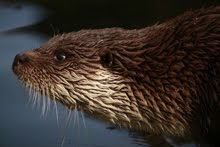
Eurasian Otters in Europe and Austria

I have just been reading about the Eurasian Otter (Lutra lutra, Fischotter) and they are, as you can well imagine, completely fascinating creatures.

First of all, their home ranges are HUGE. Males in Scotland have territories along streams and shorelines 39km long, while females only use 16-22km. They will have a good number of resting areas spread out throughout the home range. These otter resting areas are either underground, dry grass-lined dens often with an underwater entrance and separate breathing entrance (holts), and above-ground "hovers". In the areas where they are nocturnal, they typically travel 3-10km in an evening while hunting.

The original of this image is super-sharp and the colours on my mac screen as stunning. Probably my favorite digiscoping photo of the year. Digiscoped with a Swarovski Optik STM80HD, TLS800 and Canon 5DII.

I have not been able to find any recent evidence of otters in Tirol, with two major populations persisting in Austria: one in the north of the country (Waldviertel, Weinviertel in Upper Austria and Lower Austria), and one in the southeast of the country (Styria, Steiermark).

Map from the Naturschutzbund Niederösterreich report "Zur Situation des Fischotters in Österreich: Verbreitung, Lebensraum, Schutz". Green is where they were found in 2000. Red or orange means they were not found. White means the area was not investigated but unlikely to hold otters.


The two photos here are my favourite of the few digiscoping images I managed to get of the otters in Alpenzoo recently. They were both taken with a Swarovski Optik STM80 HD straight spotting scope, TLS800 digiscoping adapter, and a Canon 5D mark II.

Hopefully one day the otter will make a return to the Alps - I would love to be able to experience this incredible creature in their home environment,
Dale Forbes

Sunday, 11 April 2010

My best birding day EVER!

okay, so maybe that is just a little bit exaggerated, but last Sunday really was an awesome birding day: it is not often that I see a good number of species that I think: "WOW! Didn't expect to see you here!"

Easter Sunday saw me going out for a bit of a wander at my local patch, the Inzinger Gaisau, a calling and drumming Lesser Spotted Woodpecker (Kleinspecht) was the first bird that made me think: Nice.

But it was the Bluethroat (Blaukehlchen)
Common Snipe (Bekasine)
2 skulking Jacksnipe (Zwergschnepfe), and
2 Ring Ousel (Ringdrossel) feeding in the fields with Song Thrush (Ring Ousel is normally only found at about 1700m and above here, not at 650m asl),
that really made the morning special.

Bluethroat digiscoped on the Kazakhstani steppes last year. Swarovski Optik ATM 80HD, 25-50x zoom, DCB digiscoping adapter, Canon A590IS.

In the afternoon, Barbara and I headed down to Brixleg to go for a walk in the castle's old gardens (Schloss Matzen). There too were a good few Lesser Spotted Woodpeckers starting to breed, but it was the crazy duck on the Inn that was really special:

A single male Common Scoter (Trauerente)

Despite the name, it really is far from common here. In fact, they are more than a little rare in Tirol.


I added this photo to give an idea of how hard it was to get any photos of the duck. It was raining hard, the light was very very poor and all I had was a cheap compact camera (Canon A590 IS) and a really good pair of binoculars (new SLC HD), all done through trees. Digibinning at its extreme!


Happy birding,
Dale Forbes

Sunday, 4 April 2010

Digiscoping Capercaille up close

The Capercaille (Auerhuhn/Auerhahn) is an incredibly beautiful bird, but very seldomly seen in Tirol. We are just starting to enter the display/breeding time (Balzzeit) here in the Alps, but as a species they seem to be really struggling. Part of the issue is how the Alpine forests have changed over the past few decades, with much fewer cattle in the forests and a more intensive use of the forests. The large majority of our forests are controlled and managed by the Austrian state forestry company dedicated to maximisation of wood production, which does not exactly bode well for species that need open forest systems with canopy gaps and open areas for free flight. Wire fences and the intensive use of the forests (particularly in winter) have also made their lives harder.



Being able to see two Capercaille up close in the Alpenzoo a couple of weeks ago, afforded a great opportunity to take some close-up photos of a beautiful male Capercaille.


All photos taken with a Canon EOS 5D mark II, a Swarovski Optik STM80 HD spotting scope, and a TLS800 telephoto digiscoping adapter.

Happy digiscoping,
Dale